AP Posted Invoice Register
Description:
Application: Payables Description: Payables Posted Invoice Register
This report provides equivalent functionality to the Oracle standard Payables Posted Invoice Register report.
For scheduling the report to run periodically, use the relative period from/to offset parameters. These are the relative period offsets to the current period, so when the current period changes, the included periods will also automatically be updated when the report is re-run.
Templates
- Pivot: Summary by Account, Invoice Currency Equivalent to standard report in Summarize Report = Yes Mode
- Pivot: Summary by Account, Batch, Invoice Currency Equivalent to standard report in Summarize=No Order By=Journal Entry Batch
- Pivot: Summary by Account, Invoice Currency, Batch Equivalent to standard report in Summarize=No Order By=Entered Currency
- Detail Provides detail listing of the posted invoices
Additional data fields are available. Run the report without a template to see full list available fields
Source: Payables Posted Invoice Register Short Name: APXPOINV DB package: XLA_JELINES_RPT_PKG
Also requires custom package XXEN_XLA package to be installed to initialize the hidden parameters removed from the report to simplify scheduling of the report.
Parameters
Operating Unit, Ledger/Ledger Set, Period From, Period To, Journal Source, Include Zero Amount Lines, Account Flexfield From, Account Flexfield To, GL Batch Name, Include Manual Entries from GL, Relative Period From, Relative Period To
Used tables
ap_holds_all, &lp_template_table, xla_ae_headers, xla_transaction_entities, xla_events, ap_invoices_all
Categories
Dependencies
If you would like to try one of these Oracle EBS SQLs without having Blitz Report installed, note that some of the reports require functions from utility package xxen_util.
Example Report
Report SQL
www.enginatics.com/reports/ap-posted-invoice-register/
Blitz Report™ import options
AP_Posted_Invoice_Register.xml
Case Study & Technical Analysis: AP Posted Invoice Register
1. Executive Summary
Business Problem
The “Posting” process (transferring data from Payables to the General Ledger) is the final step in the AP cycle. Finance teams need to verify that all approved invoices have been successfully transferred to the GL to ensure month-end completeness. Standard Oracle reports for this are often rigid, making it hard to reconcile specific GL batches back to the individual invoices that comprise them.
Solution Overview
The AP Posted Invoice Register is a flexible, high-performance alternative to the standard APXPOINV report. It lists all AP invoices that have been posted to the General Ledger within a specific period. Crucially, it includes the GL Batch Name and Header ID, allowing users to seamlessly cross-reference a line in a GL Journal back to the specific AP Invoice Number and Supplier.
Key Benefits
- Reconciliation: The “Rosetta Stone” between AP and GL. If a GL account balance looks wrong, this report shows exactly which invoices fed into it.
- Period Close: Verifies that all eligible invoices for the period have been posted (Status = ‘P’).
- Drill-Down: Provides the granular detail (Invoice Line, Distribution Line) behind summarized GL journal entries.
2. Technical Analysis
Core Tables and Views
This report is heavily anchored in the Subledger Accounting (SLA) schema:
XLA_AE_HEADERS/XLA_AE_LINES: The source of truth for posted accounting. These tables store the debits and credits exactly as they were sent to GL.AP_INVOICES_ALL: Provides the operational context (Supplier, Invoice Num).GL_JE_BATCHES/GL_JE_HEADERS: The destination in the General Ledger.XLA_TRANSACTION_ENTITIES: The bridge table linking the generic SLA engine to the specific AP application.
SQL Logic and Data Flow
The query starts from the “Accounted” perspective rather than the “Transactional” perspective.
- Driver:
XLA_AE_HEADERSwhereGL_TRANSFER_STATUS_CODE = 'Y'(Posted). - Join to AP: Uses
SOURCE_ID_INT_1inXLA_TRANSACTION_ENTITIESto join back toAP_INVOICES_ALL.INVOICE_ID. - Filtering: Filters by
Ledger,Period, and optionallyAccount Flexfieldto isolate specific accounts (e.g., Liability or Expense). - Relative Periods: Supports “Relative Period” parameters (e.g., “Current Period - 1”), making it ideal for automated scheduling.
Integration Points
- General Ledger: This report is essentially a “Subledger Drilldown” report, mirroring the data found in GL Drilldown pages but in a flat, exportable format.
3. Functional Capabilities
Parameters & Filtering
- Period From/To: Standard date range selection.
- GL Batch Name: Allows users to investigate a specific suspicious batch found in the GL.
- Account Flexfield: Filter for a specific natural account (e.g., “Show me all postings to the ‘Office Supplies’ account”).
- Include Zero Amount Lines: Toggle to show/hide net-zero adjustments.
Performance & Optimization
- Indexed Access: Querying
XLA_AE_HEADERSbyPERIOD_NAMEandLEDGER_IDleverages the primary partitioning keys of the SLA tables, ensuring rapid retrieval even in high-volume environments.
4. FAQ
Q: Why does this report show different amounts than the “Invoice Register”? A: The Invoice Register shows entered amounts. This report shows accounted amounts. Differences can arise due to exchange rate variances, tax calculations, or SLA rules that modify the accounting derivation.
Q: Can I see unposted invoices here? A: No, this report is specifically for Posted items. Use the “Unaccounted Transactions” report for items stuck in AP.
Q: What is the “Pivot” template? A: The Pivot template summarizes the data by Account and Currency, mimicking the “Summarize Report = Yes” option in the standard Oracle report, but with the ability to drill down in Excel.
Oracle E-Business Suite Reporting Library
We provide an open source Oracle EBS SQLs as a part of operational and project implementation support toolkits for rapid Excel reports generation.
Blitz Report™ is based on Oracle EBS forms technology, and hence requires minimal training. There are no data or performance limitations since the output files are created directly from the database without going through intermediate file formats such as XML.
Blitz Report can be used as BI Publisher and Oracle Discoverer replacement tool. Standard Oracle BI Publisher and Discoverer reports can also be imported into Blitz Report for immediate output to Excel. Typically, reports can be created and version tracked within hours instead of days. The concurrent request output automatically opens upon completion without the need for re-formatting.
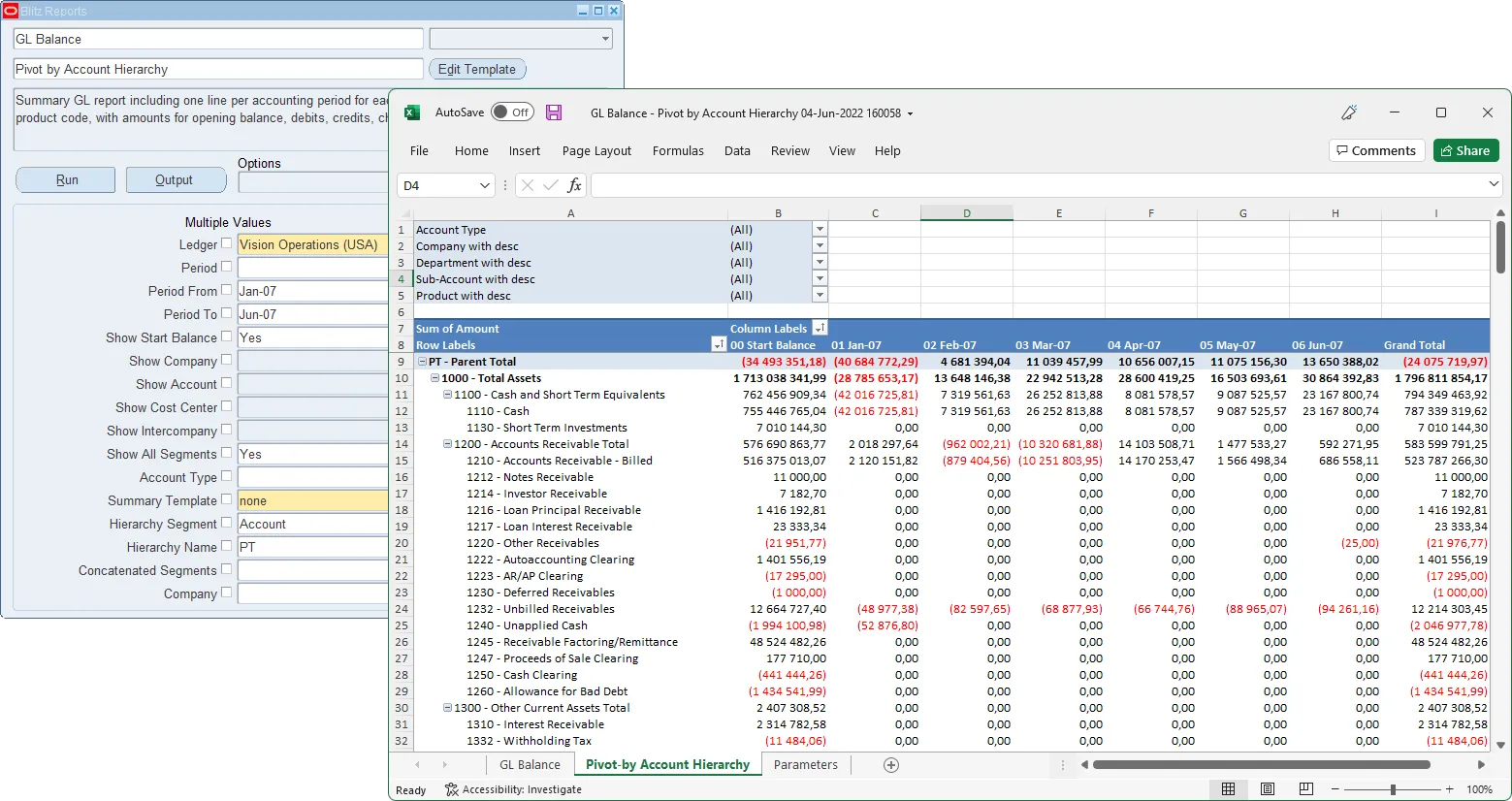
The Filters, Columns, Rows and Values fields are used to create and deliver the data in pivot table format with full drill down to details.
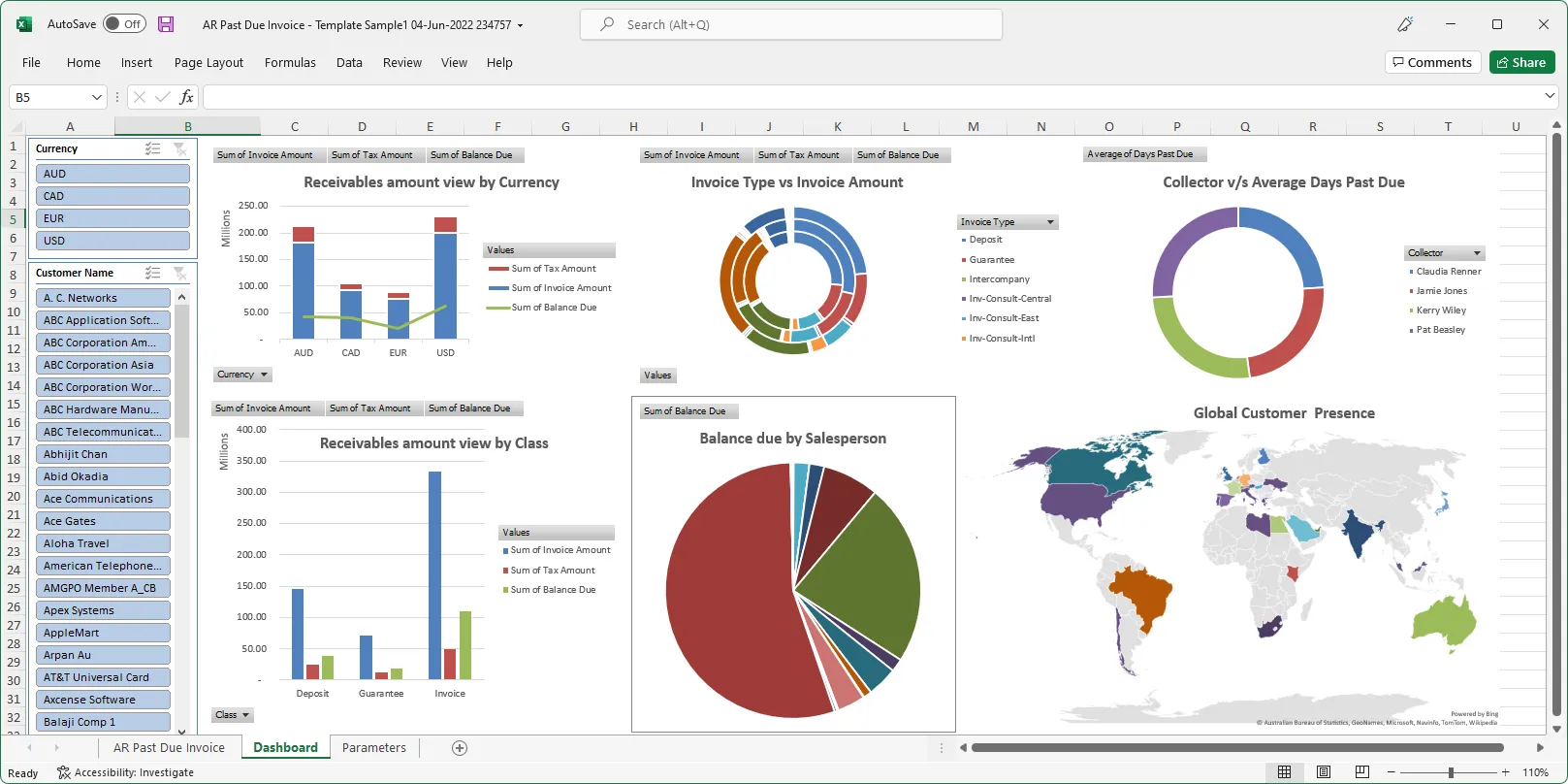
The Excel template upload functionality in Blitz Report allows users to create their own layouts by uploading an Excel template with additional sheets and charts, automatically refreshed when the report runs again. This allows to create custom dashboards and more advanced visualizations of report data.
You can download and use Blitz Report free of charge for your first 30 reports.
The installation and implementation process usually takes less than 1 hour; you can refer to our installation and user guides for specific details.
If you would like to optimize your Oracle EBS implementation and or operational reporting you can visit www.enginatics.com to review great ideas and example usage in blog. Or why not try for yourself in our demo environment.
Useful Links
Blitz Report™ – World’s fastest data upload and reporting for Oracle EBS
Oracle Discoverer replacement – importing worksheets into Blitz Report™
Blitz Report™ Questions & Answers
Supply Chain Hub by Blitz Report™
© 2025 Enginatics