BOM Calendars
Description:
Bill of material calendars and calendar dates
Parameters
Calendar, Show Organizations, Organization Code, Show Dates, Future only
Used tables
bom_calendars, bom_calendar_dates, mtl_parameters, hr_all_organization_units_vl
Categories
Related reports
Dependencies
If you would like to try one of these Oracle EBS SQLs without having Blitz Report installed, note that some of the reports require functions from utility package xxen_util.
Example Report
Report SQL
www.enginatics.com/reports/bom-calendars/
Blitz Report™ import options
Case Study & Technical Analysis: BOM Calendars Report
Executive Summary
The BOM Calendars report provides a comprehensive operational view of the manufacturing and planning calendars defined within Oracle E-Business Suite. These calendars are the backbone of supply chain planning, determining working days, shifts, and exceptions for manufacturing resources. This report offers a streamlined way to audit, validate, and visualize calendar configurations across the enterprise, ensuring that production schedules align with actual working capacity.
Business Challenge
In complex manufacturing environments, maintaining accurate calendars is critical but often overlooked.
- Scheduling Errors: Incorrect calendar definitions (e.g., missing holidays or incorrect shift patterns) can lead to unrealistic production schedules and missed delivery dates.
- Visibility Gaps: Standard Oracle forms make it difficult to compare calendars across multiple organizations or to see a holistic view of working vs. non-working days over a long horizon.
- Planning Failures: MRP and ASCP engines rely heavily on these calendars. Discrepancies between the system calendar and the physical plant reality result in planning exceptions and material shortages.
The Solution
The BOM Calendars report solves these challenges by extracting calendar definitions and their associated dates directly from the database into a flexible Excel format.
- Operational View: Users can quickly list all calendars, their start/end dates, and their assignment to specific inventory organizations.
- Detailed Audit: The report allows for expanding the view to individual calendar dates, making it easy to spot-check holidays, weekends, and exception days.
- Cross-Organization Comparison: By enabling organization details, planners can verify that all relevant plants are using the correct master calendar.
Technical Architecture (High Level)
This report is built on a robust SQL query that joins calendar header information with detailed date records and organization assignments.
Primary Tables
BOM_CALENDARS: Stores the header information for calendars (Code, Description, Start/End Dates).BOM_CALENDAR_DATES: Contains the individual dates for each calendar, indicating working or non-working status.MTL_PARAMETERS: Links calendars to Inventory Organizations.HR_ALL_ORGANIZATION_UNITS_VL: Provides human-readable organization names.
Logical Relationships
- The core logic starts with
BOM_CALENDARS. - It performs an Outer Join to
BOM_CALENDAR_DATESto optionally retrieve the specific dates associated with each calendar. - It also performs an Outer Join to
MTL_PARAMETERS(and subsequentlyHR_ALL_ORGANIZATION_UNITS_VL) to identify which organizations are utilizing a specific calendar code. - The query uses dynamic columns (controlled by parameters) to toggle the display of detailed date rows and organization mappings, ensuring the output is not cluttered when high-level summaries are needed.
Parameters & Filtering
The report includes several parameters to tailor the output to specific needs:
- Calendar: Allows filtering for a specific calendar code (e.g., ‘MFG-01’).
- Show Organizations: A ‘Yes/No’ toggle. When set to ‘Yes’, the report lists every organization assigned to the calendar.
- Organization Code: Filters the results to show calendars associated with a specific inventory organization.
- Show Dates: A ‘Yes/No’ toggle. When set to ‘Yes’, the report expands to show every individual date record (working/non-working) for the selected range.
- Future only: Restricts the output to dates from the current day forward, useful for planning future capacity.
Performance & Optimization
- Efficient Joins: The report uses standard Oracle joins on indexed columns (
CALENDAR_CODE,ORGANIZATION_ID), ensuring fast execution even with large datasets. - Dynamic Granularity: By making the “Dates” and “Organizations” joins optional via parameters, the report avoids retrieving millions of rows of date details when only a header-level list is required.
- Direct Extraction: Data is pulled directly from the base tables, bypassing the overhead of XML parsing often found in standard Oracle reports.
FAQ
Q: Why don’t I see any dates in the output? A: Ensure the “Show Dates” parameter is set to ‘Yes’. By default, the report may only show the calendar header information to keep the output concise.
Q: How can I see which organizations are using a specific calendar? A: Set the “Show Organizations” parameter to ‘Yes’. This will add columns for Organization Code and Name to the output.
Q: Can I use this report to find expired calendars?
A: Yes, the report includes Calendar End Date. You can filter the Excel output to find calendars that have already ended or are expiring soon.
Oracle E-Business Suite Reporting Library
We provide an open source Oracle EBS SQLs as a part of operational and project implementation support toolkits for rapid Excel reports generation.
Blitz Report™ is based on Oracle EBS forms technology, and hence requires minimal training. There are no data or performance limitations since the output files are created directly from the database without going through intermediate file formats such as XML.
Blitz Report can be used as BI Publisher and Oracle Discoverer replacement tool. Standard Oracle BI Publisher and Discoverer reports can also be imported into Blitz Report for immediate output to Excel. Typically, reports can be created and version tracked within hours instead of days. The concurrent request output automatically opens upon completion without the need for re-formatting.
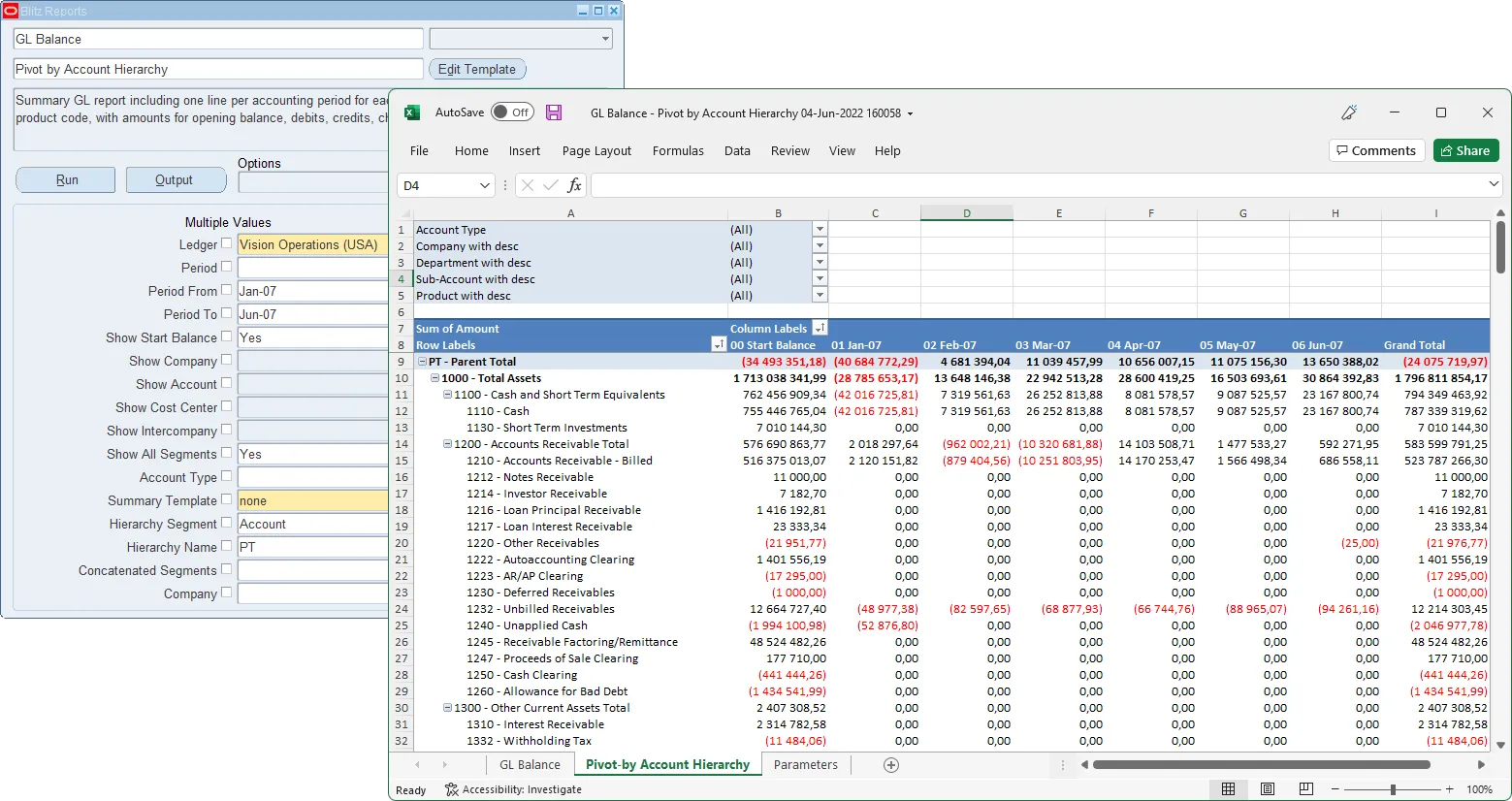
The Filters, Columns, Rows and Values fields are used to create and deliver the data in pivot table format with full drill down to details.
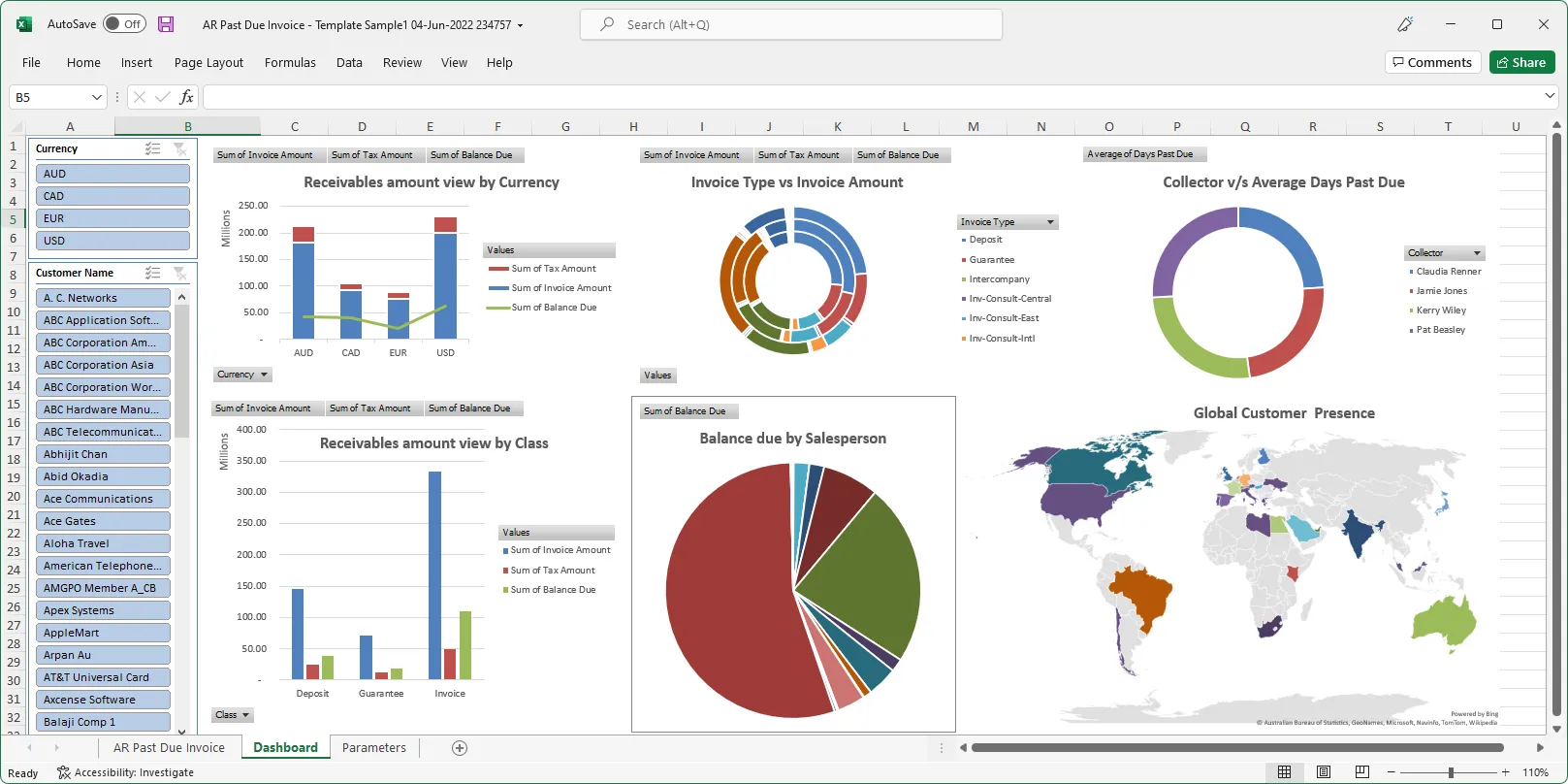
The Excel template upload functionality in Blitz Report allows users to create their own layouts by uploading an Excel template with additional sheets and charts, automatically refreshed when the report runs again. This allows to create custom dashboards and more advanced visualizations of report data.
You can download and use Blitz Report free of charge for your first 30 reports.
The installation and implementation process usually takes less than 1 hour; you can refer to our installation and user guides for specific details.
If you would like to optimize your Oracle EBS implementation and or operational reporting you can visit www.enginatics.com to review great ideas and example usage in blog. Or why not try for yourself in our demo environment.
Useful Links
Blitz Report™ – World’s fastest data upload and reporting for Oracle EBS
Oracle Discoverer replacement – importing worksheets into Blitz Report™
Blitz Report™ Questions & Answers
Supply Chain Hub by Blitz Report™
© 2025 Enginatics