CAC Intercompany SO Price List vs. Item Cost Comparison
Description:
Report to show the internal SO price lists, source org item costs and compare against the “To Org” item costs and PII (profit in inventory) amounts. This report is used to ensure the profit in inventory (PII) cost model is working correctly.
Parameters:
Price Effective Date: the date the sales order list prices are effective (mandatory). Currency Conversion Date: the exchange rate conversion date to use to convert the sales price to the same currency as the item cost (mandatory). Currency Conversion Type: the desired currency conversion type to use to convert the sales price to the same currency as the item cost (mandatory). PII Cost Type: the profit in inventory cost type you wish to report (mandatory). PII Sub-Element: the sub-element or resource for profit in inventory, such as PII or ICP (mandatory). Assignment Set: the set of sourcing rules to use with calculating the PII item costs (mandatory). Cost Type: the cost type to use for the item costs, such as Frozen or Pending (mandatory). Category Set: any item category you wish, typically the Cost or Product Line category set (optional). Item Number: enter the specific item numbers(s) you wish to report (optional). Operating Unit: enter the specific operating unit(s) you wish to report (optional). To Org Code: enter the specific To Org you wish to report (optional). To Operating Unit: enter the specific operating unit(s) you wish to report (optional). To Org Ledger: enter the specific “To Org” ledger(s) you wish to report (optional).
/* +=============================================================================+ – | Copyright 2010 - 2024 Douglas Volz Consulting, Inc. – | All rights reserved. – | Permission to use this code is granted provided the original author is – | acknowledged. No warranties, express or otherwise is included in this permission. – +=============================================================================+ – | – | Original Author: Douglas Volz (doug@volzconsulting.com) – | – | Program Name: xxx_so_price_cost_pii_rept.sql – | – | Version Modified on Modified by Description – | ======= =========== ========================================= – | 1.0 26 Nov 2010 Douglas Volz Created initial Report – | 1.18 13 Dec 2018 Douglas Volz Add Source Org OU to the InterCo_OUs inline table, to ensure – | uniqueness. Add Source Org joins for Src_Org item costs. – | Removed Release 11i edits. Replaced gl.name with gl.short_name. – | 1.19 17 Jun 2019 Douglas Volz Replace Oracle function apps.qp_price_list_pvt.get_product_uom_code – | with “and ucr.uom_code = qpa.product_uom_code”. Comment out Source – | and To Org Added Costs columns. – | 1.20 21 Aug 2019 Douglas Volz Removed client-specific SQL logic. – | 1.21 25 Oct 2019 Douglas Volz Correction to p_price_effective_date parameter – | 1.22 17 Jul 2022 Douglas Volz Changes for multi-language lookup values. Changed – | back to Oracle QP price packages, to get price list – | information based on both category or item-specific price lists. – | 1.23 28 Nov 2023 Andy Haack Added G/L security for the “To Org” G/L and removed tabs. – | 1.24 06 Feb 2024 Douglas Volz Fix for G/L Daily Rates and add “To Org” inventory security. – | 1.25 25 Jun 2024 Douglas Volz Reinstall missing parameters, Item Number and To Operating Unit. – +=============================================================================+*/
Parameters
Price Effective Date, Currency Conversion Date, Currency Conversion Type, PII Cost Type, PII Sub-Element, Assignment Set, Cost Type, Category Set, Item Number, To Org Code, To Operating Unit, To Org Ledger
Used tables
hz_cust_site_uses_all, mtl_intercompany_parameters, hz_cust_acct_sites_all, hz_cust_accounts, qp_list_headers_b, qp_list_headers_tl, qp_list_lines, mtl_system_items_vl, mtl_uom_conversions_view, mtl_item_status_vl, cst_item_cost_details, cst_cost_types, bom_resources, cst_item_costs, mtl_parameters, mtl_categories_v, mtl_item_categories, mtl_category_sets_b, mtl_category_sets_tl, mrp_sr_source_org, mrp_sr_receipt_org, mrp_sr_assignments, mrp_assignment_sets, hr_organization_information, hr_all_organization_units_vl, gl_ledgers, mfg_lookups, fnd_common_lookups
Categories
Dependencies
If you would like to try one of these Oracle EBS SQLs without having Blitz Report installed, note that some of the reports require functions from utility package xxen_util.
Example Report
CAC Intercompany SO Price List vs. Item Cost Comparison 11-Jul-2022 140147.xlsx
Report SQL
www.enginatics.com/reports/cac-intercompany-so-price-list-vs-item-cost-comparison/
Blitz Report™ import options
CAC_Intercompany_SO_Price_List_vs_Item_Cost_Comparison.xml
Case Study & Technical Analysis: CAC Intercompany SO Price List vs. Item Cost Comparison
Executive Summary
The CAC Intercompany SO Price List vs. Item Cost Comparison report is a high-value financial control tool used to validate the “Profit in Inventory” (PII) cost model. It performs a three-way comparison between the Internal Sales Order (ISO) price, the Source Organization’s item cost, and the Destination Organization’s item cost. This ensures that intercompany margins are calculated correctly and that the transfer price covers the cost of goods sold plus the intended markup.
Business Challenge
Global organizations often move goods between entities with a markup (Profit in Inventory).
- Margin Integrity: If the transfer price (Price List) is lower than the source cost, the sending entity loses money on the transfer.
- PII Accuracy: The “Profit in Inventory” element in the destination cost must accurately reflect the difference between the transfer price and the source cost.
- Currency Fluctuations: Comparing costs and prices across different currencies (e.g., USD to EUR) adds a layer of complexity that manual spreadsheets struggle to handle.
Solution
This report automates the complex reconciliation of intercompany costs and prices.
- Currency Conversion: Automatically converts sales prices to the same currency as the item cost using a user-specified exchange rate and date.
- PII Validation: Explicitly calculates and reports the PII amount, allowing for immediate verification against the PII Cost Type.
- Sourcing Logic: Uses the Assignment Set to determine the valid sourcing rules, ensuring the comparison reflects the actual supply chain flow.
Technical Architecture
The report executes a sophisticated analysis across multiple modules:
- Pricing: Retrieves data from
qp_list_headersandqp_list_lines. - Costing: Queries
cst_item_costsfor both the Source and Destination organizations. - Sourcing Rules: Integrates with
mrp_sourcing_rulesandmrp_sr_assignmentsto identify the valid supply paths. - GL Integration: Uses
gl_daily_ratesto handle currency conversions dynamically.
Parameters
- Price Effective Date: (Mandatory) Date for price lookup.
- Currency Conversion Date/Type: (Mandatory) Parameters to standardize the currency for comparison.
- PII Cost Type: (Mandatory) The cost type holding the profit element (e.g., ‘PII’).
- Cost Type: (Mandatory) The standard cost type (e.g., ‘Frozen’).
- Assignment Set: (Mandatory) Defines the supply chain network to analyze.
Performance
- Complex Calculation: This is a computation-heavy report due to the need to resolve sourcing rules and perform currency conversions for every item.
- Strategic Use: Best run for specific categories or operating units rather than a full database dump, especially in large environments.
FAQ
Q: What is PII? A: Profit in Inventory (PII) represents the intercompany profit included in the inventory value of the receiving organization. It must be eliminated for consolidated financial reporting.
Q: Why do I need an Assignment Set? A: The Assignment Set tells the report which Source Organization supplies the Destination Organization, which is essential for picking the correct source cost for comparison.
Q: Does it handle different currencies? A: Yes, the report includes mandatory parameters for Currency Conversion Date and Type to normalize all figures to a single currency.
Oracle E-Business Suite Reporting Library
We provide an open source Oracle EBS SQLs as a part of operational and project implementation support toolkits for rapid Excel reports generation.
Blitz Report™ is based on Oracle EBS forms technology, and hence requires minimal training. There are no data or performance limitations since the output files are created directly from the database without going through intermediate file formats such as XML.
Blitz Report can be used as BI Publisher and Oracle Discoverer replacement tool. Standard Oracle BI Publisher and Discoverer reports can also be imported into Blitz Report for immediate output to Excel. Typically, reports can be created and version tracked within hours instead of days. The concurrent request output automatically opens upon completion without the need for re-formatting.
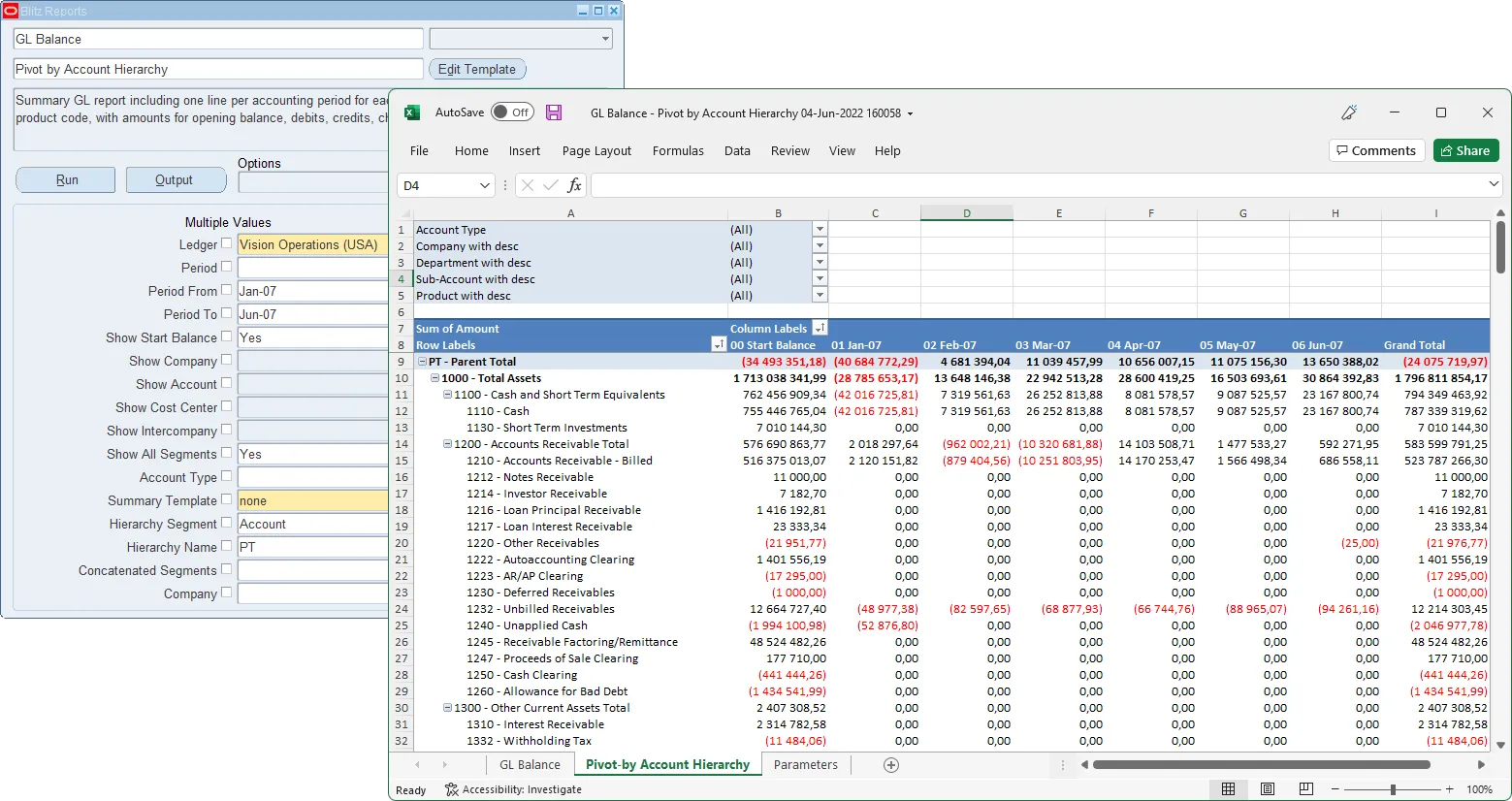
The Filters, Columns, Rows and Values fields are used to create and deliver the data in pivot table format with full drill down to details.
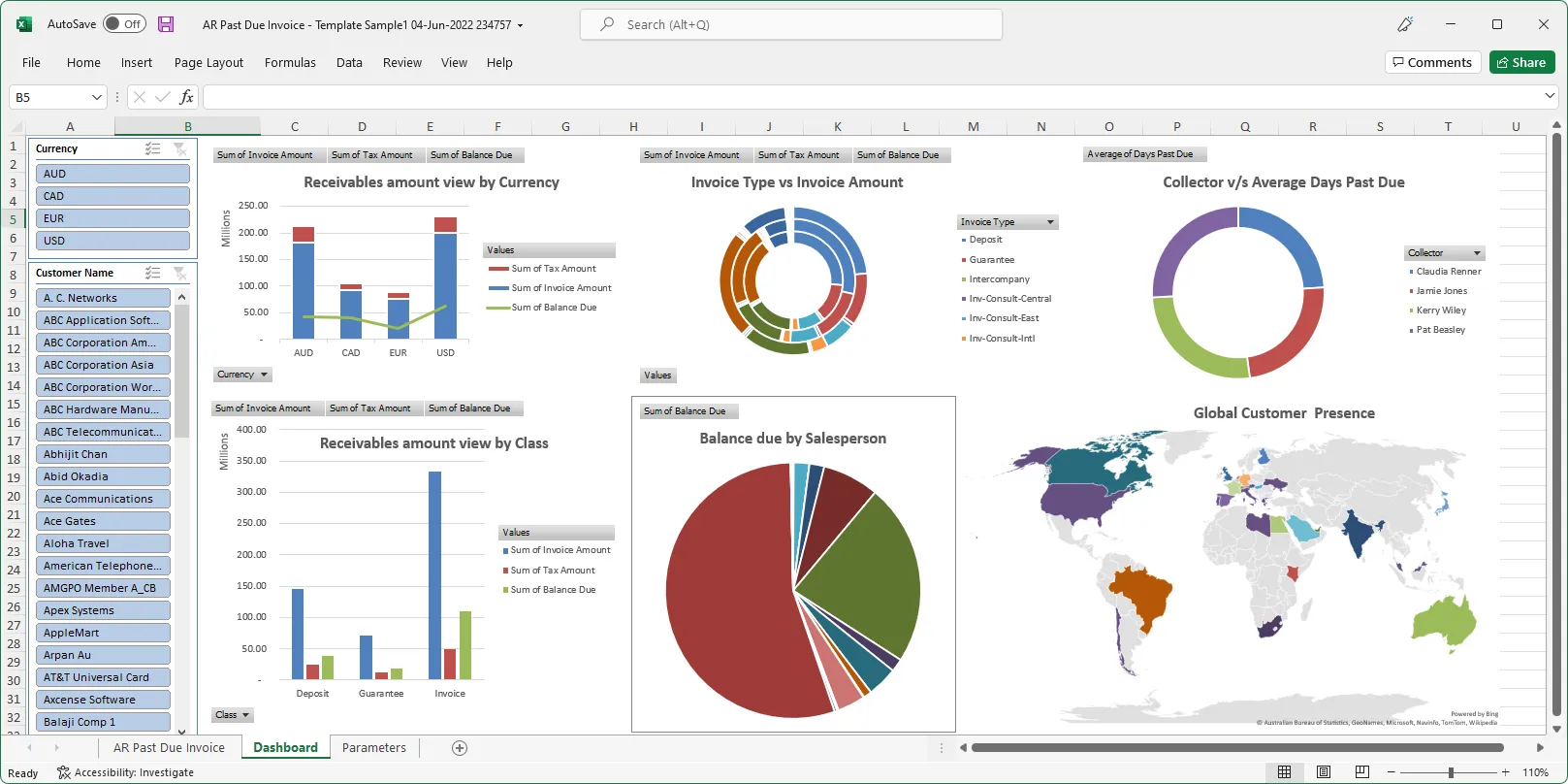
The Excel template upload functionality in Blitz Report allows users to create their own layouts by uploading an Excel template with additional sheets and charts, automatically refreshed when the report runs again. This allows to create custom dashboards and more advanced visualizations of report data.
You can download and use Blitz Report free of charge for your first 30 reports.
The installation and implementation process usually takes less than 1 hour; you can refer to our installation and user guides for specific details.
If you would like to optimize your Oracle EBS implementation and or operational reporting you can visit www.enginatics.com to review great ideas and example usage in blog. Or why not try for yourself in our demo environment.
Useful Links
Blitz Report™ – World’s fastest data upload and reporting for Oracle EBS
Oracle Discoverer replacement – importing worksheets into Blitz Report™
Blitz Report™ Questions & Answers
Supply Chain Hub by Blitz Report™
© 2025 Enginatics