CAC Inventory and Intransit Value (Period-End)
Description:
Report showing amount of inventory at the end of the month. If you enter a cost type this report uses the item costs from the cost type; if you leave the cost type blank it uses the item costs from the month-end snapshot. In either case this report uses the month-end quantities, based on the entered period name. And as these quantities come from the month-end snapshot (created when you close the inventory accounting period) and this snapshot is only by inventory organization, subinventory and item and not split out by cost element, this report only shows the Material Account, based upon your Costing Method.
Note: if you enter a cost type this report uses the item costs from the cost type; if you leave the cost type blank it uses the item costs from the month-end snapshot.
/* +=============================================================================+ – | Copyright 2009 - 2022 Douglas Volz Consulting, Inc. | – | All rights reserved. | – | Permission to use this code is granted provided the original author is | – | acknowledged. No warranties, express or otherwise is included in this | – | permission. | – +=============================================================================+ – | – | Original Author: Douglas Volz (doug@volzconsulting.com) – | – | Parameters: – | p_period_name – Accounting period you wish to report for – | p_org_code – Specific inventory organization you wish to report (optional) – | p_operating_unit – Operating Unit you wish to report, leave blank for all operating units (optional) – | p_ledger – general ledger you wish to report, leave blank for all ledgers (optional) – | p_cost_type – Enter a Cost Type to value the quantities using the Cost Type Item Costs; or, if – | Cost Type is blank or null the report will use the stored month-end snapshot values – | p_category_set1 – The first item category set to report, typically the Cost or Product Line Category Set – | p_category_set2 – The second item category set to report, typically the Inventory Category Set – | p_item_number – The part or item number you wish to report (optional) – | p_subinventory – The specific subinventory you wish to report (optional) – | – | =================================================================== – | Version Modified on Modified by Description – | ======= =========== ============== ========================================= – | 1.0 27 Sep 2009 Douglas Volz Initial Coding – | 1.1 28 Sep 2009 Douglas Volz Added a sum for the ICP costs from cicd – | 1.16 23 Apr 2020 Douglas Volz Changed to multi-language views for the item master, – | item categories and operating units. Used mfg_lookups for “Intransit”. – | 1.17 05 Mar 2022 Douglas Volz Use With statement for category, subinventory and intransit valuation accounts. – | And changed from four union all statements to only two. – | 1.18 11 Mar 2022 Douglas Volz Performance improvements for category accounting – | 1.19 20 Mar 2022 Douglas Volz Fix for category accounts (valuation accounts) and – | added subinventory description. – | 1.20 19 Oct 2022 Douglas Volz Fix for valuation accounts, causing duplicate rows. – | 1.21 21 Oct 2022 Douglas Volz Fix for detecting Cost Group Accounting. – +=============================================================================+*/
Parameters
Period Name (Closed), Cost Type, Category Set 1, Category Set 2, Category Set 3, Item Number, Subinventory, Organization Code, Operating Unit, Ledger
Used tables
mtl_secondary_inventories, inv_organizations, cst_cost_group_accounts, cst_cost_groups, mtl_categories_b, mtl_category_sets_b, mtl_item_categories, mtl_category_accounts, mtl_interorg_parameters, valuation_accounts, mtl_units_of_measure_vl, mtl_item_status_vl, gl_code_combinations, fnd_common_lookups, mfg_lookups, select, inventory_item_id, concatenated_segments, regexp_replace, primary_uom_code, inventory_item_status_code, item_type, inventory_asset_flag, period_name, acct_period_id, nvl, sum, cst_period_close_summary, org_acct_periods, subinventory_code, cst_cost_types, cst_item_costs, category_organization_id, category_set_id, category_id, inventory_item_id, concatenated_segments, description, primary_uom_code, inventory_item_status_code, item_type, period_name, subinventory_code, mtl_system_items_vl
Categories
Dependencies
If you would like to try one of these Oracle EBS SQLs without having Blitz Report installed, note that some of the reports require functions from utility package xxen_util.
Example Report
CAC Inventory and Intransit Value (Period-End) - Discrete OPM - Pivot by Org 02-Aug-2024 142029.xlsx
Report SQL
www.enginatics.com/reports/cac-inventory-and-intransit-value-period-end/
Blitz Report™ import options
CAC_Inventory_and_Intransit_Value_Period_End.xml
Case Study & Technical Analysis: CAC Inventory and Intransit Value (Period-End)
Executive Summary
The CAC Inventory and Intransit Value (Period-End) report provides a critical financial view of inventory assets at the close of an accounting period. It enables finance and supply chain teams to reconcile inventory subledger balances with the General Ledger, ensuring accurate financial reporting and compliance. By leveraging period-end snapshots, it offers a stable and auditable record of inventory value.
Business Challenge
- Reconciliation Difficulties: reconciling dynamic inventory balances to static GL period-end balances is often prone to timing errors.
- Valuation Flexibility: Standard reports often lack the ability to simulate inventory value using alternative cost types (e.g., for “what-if” analysis or standard cost updates).
- Granularity: High-level GL balances do not provide the item or subinventory-level detail needed to investigate variances.
The Solution
This report solves these challenges by utilizing the inventory period-close process to capture a static snapshot of quantities.
- Operational View: It provides a detailed listing of inventory value by Organization, Subinventory, and Item.
- Flexible Valuation: Users can choose to value the snapshot quantities using the actual period-end costs or apply a different
Cost Typeto analyze potential revaluation impacts. - Focus on Material: The report specifically isolates Material Account values, aligning with the primary cost element for most inventory valuations.
Technical Architecture (High Level)
- Primary Tables:
MTL_SECONDARY_INVENTORIES,INV_ORGANIZATIONS,CST_COST_GROUPS,MTL_CATEGORIES_B,CST_ITEM_COSTS,ORG_ACCT_PERIODS. - Logical Relationships:
- The report links Inventory Organizations to their respective Operating Units and Ledgers.
- It retrieves item quantities based on the period-end snapshot logic (implicitly linked to
CST_PERIOD_CLOSE_SUMMARYor similar snapshot mechanisms via the period name). - Item costs are derived either from the historical snapshot or joined from
CST_ITEM_COSTSbased on the selectedCost Type. - Category sets are joined to provide product-line classification.
Parameters & Filtering
- Period Name (Closed): Mandatory. Specifies the accounting period for which the snapshot data is retrieved. The period must be closed to ensure data integrity.
- Cost Type: Optional. If left blank, the report uses the historical costs from the period-end snapshot. If populated, it revalues the period-end quantities using the specified Cost Type (e.g., ‘Frozen’, ‘Pending’).
- Category Set 1 & 2: Allows filtering and grouping by specific item categories (e.g., Product Line, Inventory Category).
- Organization Code: Limits the report to a specific Inventory Organization.
- Subinventory: Filters for a specific storage location.
- Item Number: Focuses the analysis on a specific item.
Performance & Optimization
- Snapshot Utilization: By querying period-end snapshots rather than recalculating balances from transaction history, the report achieves high performance and consistency.
- Direct Database Extraction: The SQL bypasses the overhead of XML parsing often found in standard Oracle reports, delivering large datasets directly to Excel for pivot analysis.
- Indexed Lookups: Joins on
INVENTORY_ITEM_IDandORGANIZATION_IDleverage standard indices to ensure efficient execution even for high-volume organizations.
FAQ
Q: Why does the report require a closed period? A: The report relies on the inventory snapshot created during the period close process. Without this snapshot, there is no static record of quantities at that specific point in time.
Q: What happens if I specify a Cost Type? A: The report will take the quantities from the period end but value them using the unit costs from the selected Cost Type. This is useful for comparing “Book Value” vs. “Standard Cost” or simulating the impact of a cost update.
Q: Does this report include WIP value? A: No, this report focuses on Inventory and Intransit value. WIP value is typically reported separately via WIP Period Value reports.
Oracle E-Business Suite Reporting Library
We provide an open source Oracle EBS SQLs as a part of operational and project implementation support toolkits for rapid Excel reports generation.
Blitz Report™ is based on Oracle EBS forms technology, and hence requires minimal training. There are no data or performance limitations since the output files are created directly from the database without going through intermediate file formats such as XML.
Blitz Report can be used as BI Publisher and Oracle Discoverer replacement tool. Standard Oracle BI Publisher and Discoverer reports can also be imported into Blitz Report for immediate output to Excel. Typically, reports can be created and version tracked within hours instead of days. The concurrent request output automatically opens upon completion without the need for re-formatting.
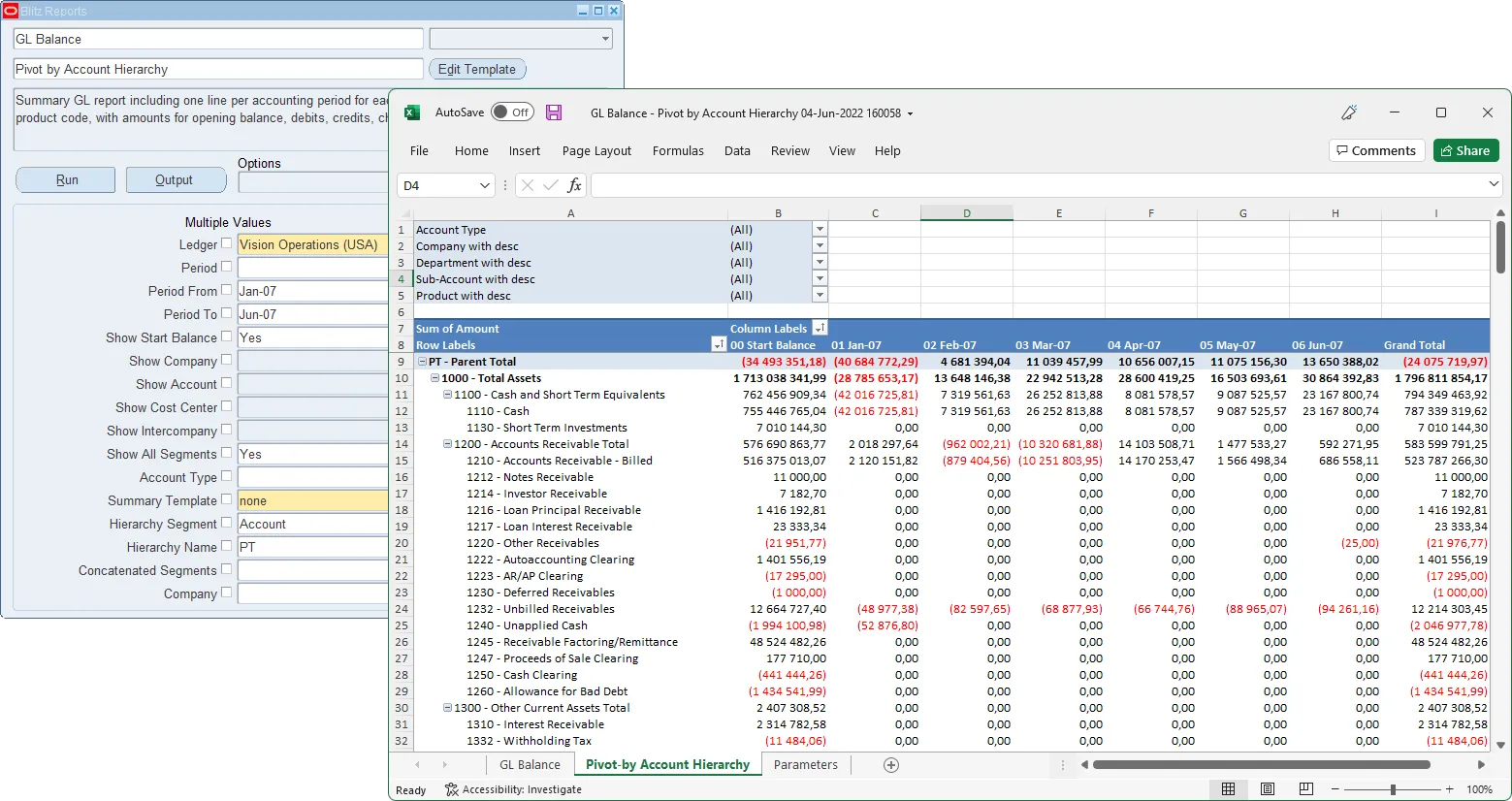
The Filters, Columns, Rows and Values fields are used to create and deliver the data in pivot table format with full drill down to details.
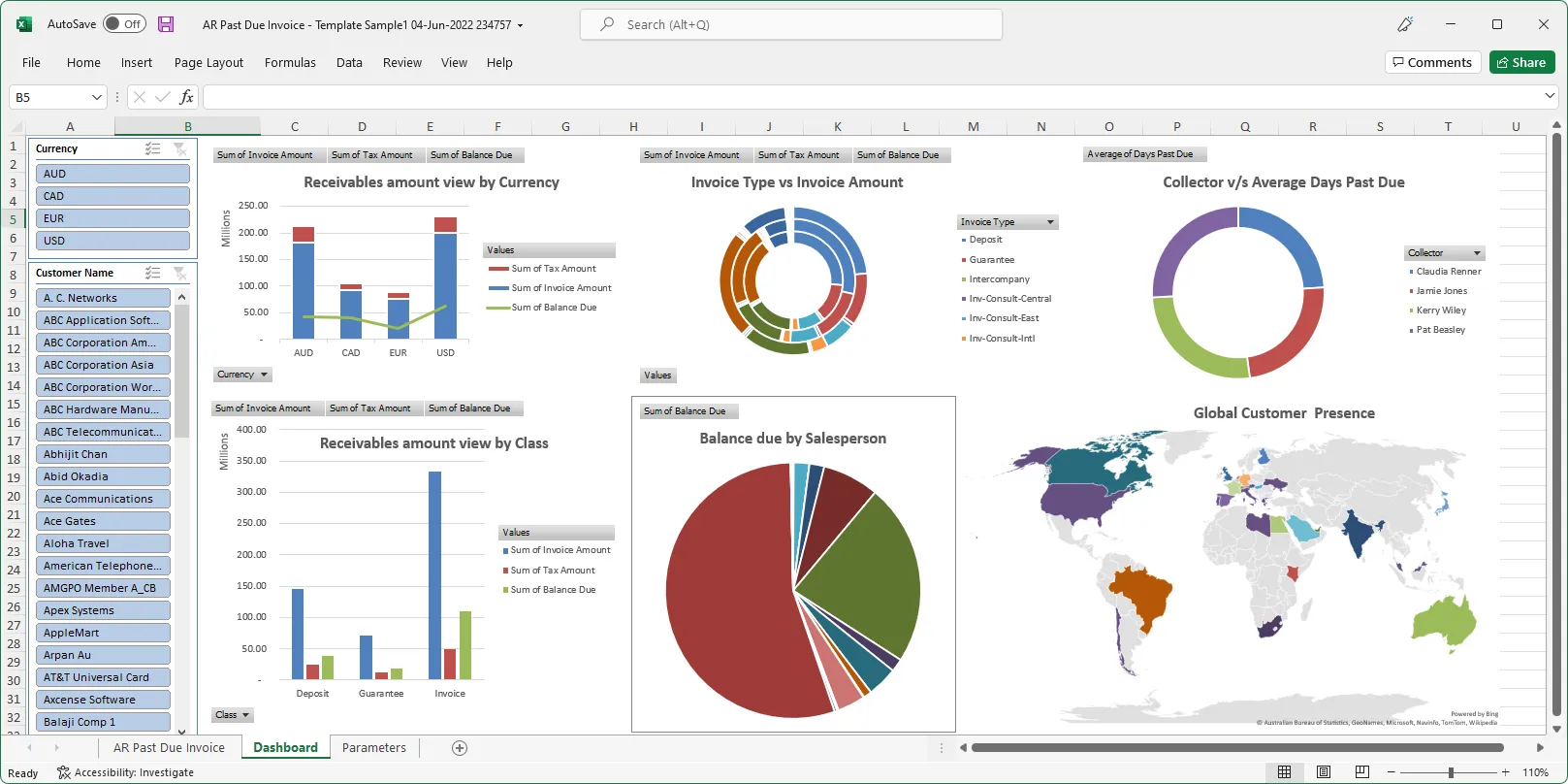
The Excel template upload functionality in Blitz Report allows users to create their own layouts by uploading an Excel template with additional sheets and charts, automatically refreshed when the report runs again. This allows to create custom dashboards and more advanced visualizations of report data.
You can download and use Blitz Report free of charge for your first 30 reports.
The installation and implementation process usually takes less than 1 hour; you can refer to our installation and user guides for specific details.
If you would like to optimize your Oracle EBS implementation and or operational reporting you can visit www.enginatics.com to review great ideas and example usage in blog. Or why not try for yourself in our demo environment.
Useful Links
Blitz Report™ – World’s fastest data upload and reporting for Oracle EBS
Oracle Discoverer replacement – importing worksheets into Blitz Report™
Blitz Report™ Questions & Answers
Supply Chain Hub by Blitz Report™
© 2025 Enginatics