DBA AWR Wait Event Summary
Description:
Summary of wait times by wait event and event class for a specified snapshot time interval. Use the Session Type parameter to restrict either to foreground, background or all server processes.
To see data in this report based on dba_hist_system_event, set the following: alter session set container=PDB1; alter system set awr_pdb_autoflush_enabled=true;
https://www.enginatics.com/blog/updated-dba-awr-blitz-reports-now-work-with-plugglable-databases/
Parameters
Date From, Date To, Session Type, Level of Detail, Request Id (Time Restriction), Time Restriction, Include Idle Events, Diagnostic Pack enabled, Container Data
Used tables
dba_hist_snapshot, dba_hist_system_event
Categories
Related reports
Dependencies
If you would like to try one of these Oracle EBS SQLs without having Blitz Report installed, note that some of the reports require functions from utility package xxen_util.
Example Report
DBA AWR Wait Event Summary 22-Dec-2025 083752.xlsx
Report SQL
www.enginatics.com/reports/dba-awr-wait-event-summary/
Blitz Report™ import options
DBA_AWR_Wait_Event_Summary.xml
Executive Summary
The DBA AWR Wait Event Summary report aggregates wait times by specific wait events and event classes for a defined snapshot interval. It is essential for DBAs to quickly identify the top contributors to database latency, enabling targeted tuning and resource optimization.
Business Challenge
- Identifying Top Waiters: Struggling to determine which specific events (e.g.,
db file scattered read,log file sync) are consuming the most database time. - Resource Contention: Inability to see if performance issues are due to disk I/O, network latency, or locking mechanisms.
- Prioritization: Difficulty in deciding which performance issues to tackle first for maximum impact.
The Solution
This Blitz Report solves these problems by:
- Aggregated View: Summarizing wait times to highlight the most significant events over the selected period.
- Categorization: Grouping events by class (e.g., System I/O, Network) for better context.
- Flexibility: Allowing filtering by session type (Foreground/Background) to focus on user-impacting events.
Technical Architecture
The report joins DBA_HIST_SNAPSHOT with DBA_HIST_SYSTEM_EVENT. It calculates the sum of TIME_WAITED_MICRO and TOTAL_WAITS for each event within the selected snapshot range. It filters out idle events (unless requested) to focus on active performance constraints.
Parameters & Filtering
- Date From / Date To: Specifies the analysis period.
- Session Type: Restricts analysis to Foreground, Background, or All processes.
- Include Idle Events: Option to include or exclude non-critical wait events (e.g.,
SQL*Net message from client).
Performance & Optimization
- Exclude Idle Events: Always keep “Include Idle Events” to ‘No’ (default) to avoid cluttering the report with irrelevant data.
- Time Restriction: Use the time parameters to narrow down the analysis to peak business hours.
FAQ
- Q: How does this differ from the “Wait Class by Time” report?
- A: This report provides a summary of specific events over the entire period, whereas “Wait Class by Time” shows classes of waits broken down by snapshot interval.
- Q: Can I use this for a specific SQL ID?
- A: No, this report is at the system/instance level. For SQL-level analysis, use “DBA AWR SQL Performance Summary”.
Oracle E-Business Suite Reporting Library
We provide an open source Oracle EBS SQLs as a part of operational and project implementation support toolkits for rapid Excel reports generation.
Blitz Report™ is based on Oracle EBS forms technology, and hence requires minimal training. There are no data or performance limitations since the output files are created directly from the database without going through intermediate file formats such as XML.
Blitz Report can be used as BI Publisher and Oracle Discoverer replacement tool. Standard Oracle BI Publisher and Discoverer reports can also be imported into Blitz Report for immediate output to Excel. Typically, reports can be created and version tracked within hours instead of days. The concurrent request output automatically opens upon completion without the need for re-formatting.
The Filters, Columns, Rows and Values fields are used to create and deliver the data in pivot table format with full drill down to details.
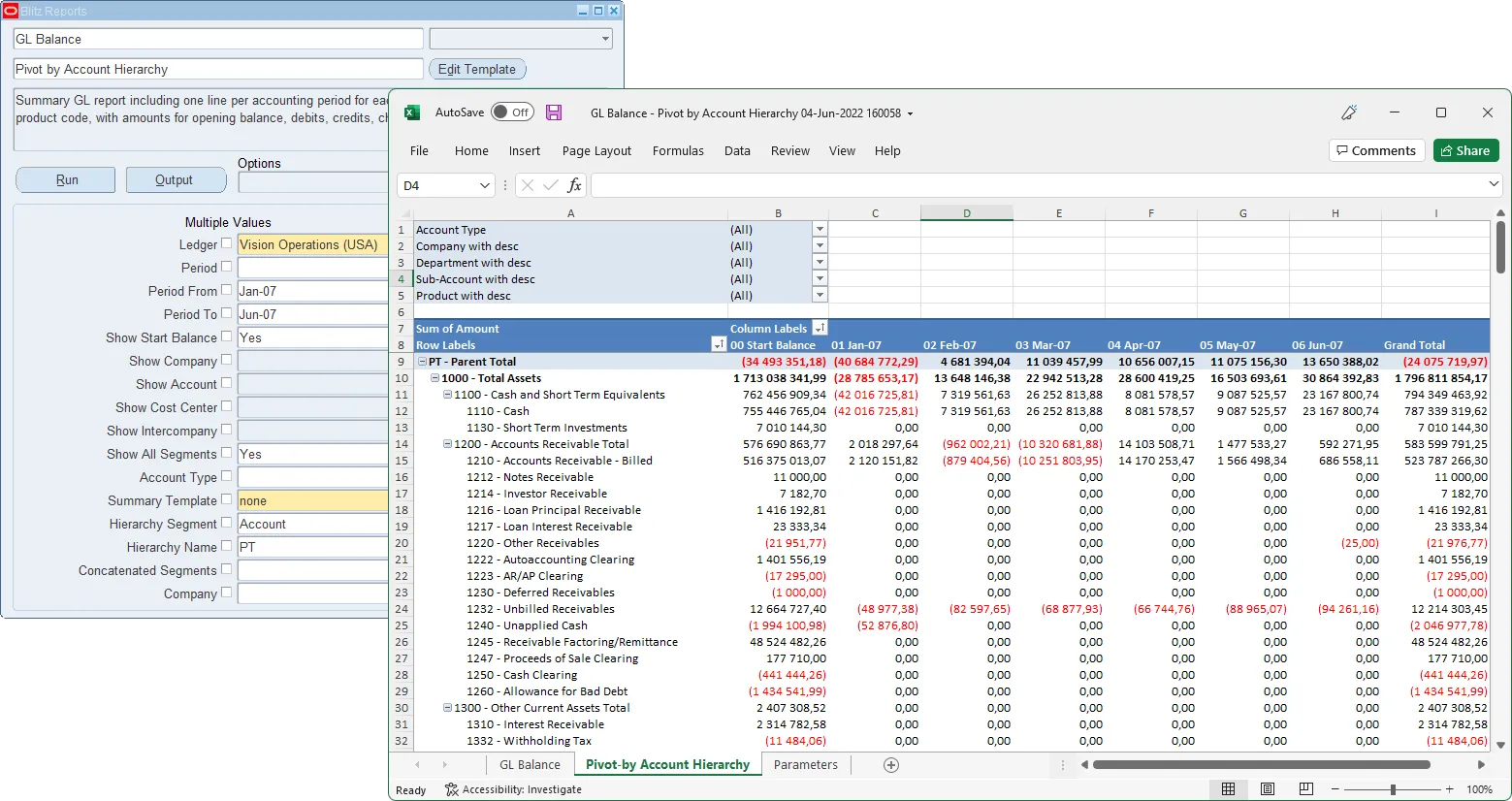
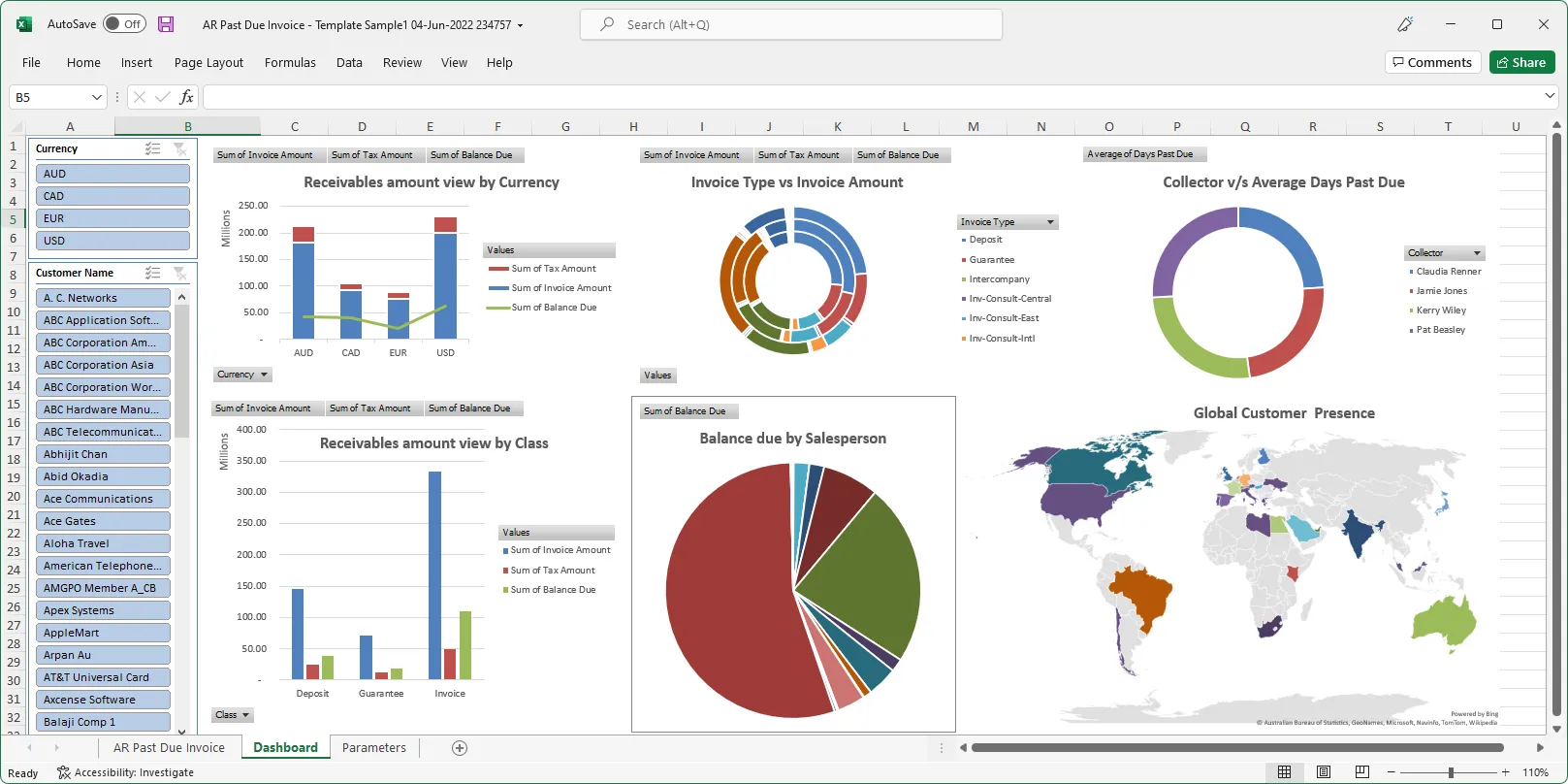
The Excel template upload functionality in Blitz Report allows users to create their own layouts by uploading an Excel template with additional sheets and charts, automatically refreshed when the report runs again. This allows to create custom dashboards and more advanced visualizations of report data.
You can download and use Blitz Report free of charge for your first 30 reports.
The installation and implementation process usually takes less than 1 hour; you can refer to our installation and user guides for specific details.
If you would like to optimize your Oracle EBS implementation and or operational reporting you can visit www.enginatics.com to review great ideas and example usage in blog. Or why not try for yourself in our demo environment.
Useful Links
Blitz Report™ – World’s fastest data upload and reporting for Oracle EBS
Oracle Discoverer replacement – importing worksheets into Blitz Report™
Blitz Report™ Questions & Answers
Supply Chain Hub by Blitz Report™
© 2025 Enginatics