PA Project Event Upload
Description:
PA Project Event Upload =================== This upload can be used to create new Project Billing and Revenue Events against the Projects belonging to the Operating Units accessible to the current responsibility.
If the Operating Unit parameter is specified, then the upload will be restricted to Projects within the specified Operating Unit only.
Parameters
Product Source, Operating Unit, Default Event Date, Validate DFF Attributes
Used tables
mtl_parameters, mtl_system_items_vl, pa_proj_elements, pa_events, pa_projects, pa_tasks, hr_all_organization_units_vl, pa_all_organizations, pa_event_types, pa_agreements, pa_customers_v, pa_conversion_types_v, mo_glob_org_access_tmp, dual
Categories
Dependencies
If you would like to try one of these Oracle EBS SQLs without having Blitz Report installed, note that some of the reports require functions from utility package xxen_util.
Example Report
Report SQL
www.enginatics.com/reports/pa-project-event-upload/
Blitz Report™ import options
Case Study & Technical Analysis: PA Project Event Upload
Executive Summary
The PA Project Event Upload is a specialized data management tool designed to streamline the creation of billing and revenue events in Oracle Projects. For businesses that manage contract-based or fixed-price projects, this tool is essential for efficiently processing milestone payments, fee schedules, and other non-standard billing triggers. By enabling the mass creation of events from a simple Excel template, it accelerates the project billing and revenue recognition cycles, improves accuracy, and reduces manual administrative effort.
Business Challenge
Project “events” are the backbone of billing and revenue recognition for many types of projects. However, the process of creating these events in the standard Oracle application can be a bottleneck.
- High Volume Manual Entry: For project managers or billing specialists who need to process dozens of completed milestones at the end of a billing period, creating each event one-by-one in the Oracle forms is extremely time-consuming and inefficient.
- Disconnect from Project Plans: Often, the list of billable milestones is maintained in an external project management system or a spreadsheet. Manually transcribing this information into Oracle to create the events is a redundant task that is prone to data entry errors in dates, amounts, or descriptions.
- Delayed Invoicing: The manual effort required to create events can delay their entry into the system, which in turn delays the generation of project invoices, negatively impacting the company’s cash flow.
- Inaccurate Revenue Recognition: Similar to billing, if revenue recognition is also event-based, delays or errors in creating revenue events can lead to inaccurate financial reporting for the period.
The Solution
This Excel-based upload tool transforms the process of creating project events from a manual, transactional task into an efficient, bulk data-loading operation.
- Accelerated Billing and Revenue Cycles: By allowing users to load a file containing many events for multiple projects at once, the tool dramatically speeds up the process of triggering invoices and recognizing revenue, leading to improved cash flow and more accurate financial statements.
- Improved Data Accuracy: Preparing event data in a spreadsheet allows for review and validation before it is loaded into Oracle. This virtually eliminates the typos and data entry mistakes common with manual processing, resulting in fewer invoice corrections and customer disputes.
- Seamless Integration with Offline Processes: The tool provides a simple and effective integration point for external data. Project managers can export milestone completion data from their project management software into the Excel template and load it directly into Oracle Projects.
- Reduced Administrative Overhead: The tool frees up project accountants and billing specialists from hours of repetitive data entry, allowing them to focus on more value-added activities like analysis and resolving exceptions.
Technical Architecture (High Level)
The upload process leverages the standard Oracle Projects APIs to ensure that all events are created with the same rigor and validation as if they were entered through the application interface.
- Primary Tables Involved:
pa_events(the core table where the project event records are created).pa_projects_all(used to validate that the specified project exists and is active).pa_tasks(used to validate the task number, if the event is at the task level).pa_event_types(used to validate the event type, e.g., ‘Milestone’, ‘Scheduled Fee’).pa_agreements_all(to link the event to the customer agreement for billing).
- Logical Relationships: For each row in the upload file, the tool’s underlying API validates all the contextual information (Project, Task, Event Type, etc.). Upon successful validation, it inserts a new record into the
pa_eventstable with the specified details, such as the event date, amount, and description.
Parameters & Filtering
The upload parameters are designed for straightforward control of the event creation process:
- Operating Unit: Restricts the upload to projects within a specific operating unit, or allows access to all available OUs.
- Default Event Date: A convenient parameter that allows the user to specify a single date to be used for all events in the upload file, unless a different date is specified on an individual line.
- Validate DFF Attributes: Allows the tool to validate any descriptive flexfield data included in the upload file before attempting the load.
Performance & Optimization
The tool is optimized for the bulk creation of transaction records.
- API-based Processing: Using the official Oracle Projects APIs for data creation is highly efficient. The APIs are designed for set-based processing, which is significantly faster and more scalable than the screen-based, one-at-a-time processing of manual entry.
FAQ
1. What is a project ‘event’ and when is it used? A project event is a record of a specific occurrence in a project’s lifecycle that is used to trigger either billing or revenue recognition. They are most commonly used in contract-based projects where billing is not based on hours worked, but on achieving specific milestones (e.g., “Phase 1 Complete”), fixed schedules, or other deliverables.
2. What is the difference between a ‘revenue’ event and a ‘billing’ event? They are distinct concepts. A ‘billing’ event triggers the creation of an invoice to the customer. A ‘revenue’ event triggers the recognition of revenue in the company’s financial statements. Sometimes a single milestone can be set up to create both a billing and a revenue event, but they can also be separate (e.g., recognize 25% of the revenue now, but bill the client next month).
3. What happens after I upload an event with this tool?
After the events are successfully created in the pa_events table, they are ready to be processed by the standard Oracle Projects concurrent programs. You would typically run the “PRC: Generate Draft Invoices” process to create customer invoices from the new billing events, and the “PRC: Generate Draft Revenue” process to accrue revenue from the new revenue events.
Oracle E-Business Suite Reporting Library
We provide an open source Oracle EBS SQLs as a part of operational and project implementation support toolkits for rapid Excel reports generation.
Blitz Report™ is based on Oracle EBS forms technology, and hence requires minimal training. There are no data or performance limitations since the output files are created directly from the database without going through intermediate file formats such as XML.
Blitz Report can be used as BI Publisher and Oracle Discoverer replacement tool. Standard Oracle BI Publisher and Discoverer reports can also be imported into Blitz Report for immediate output to Excel. Typically, reports can be created and version tracked within hours instead of days. The concurrent request output automatically opens upon completion without the need for re-formatting.
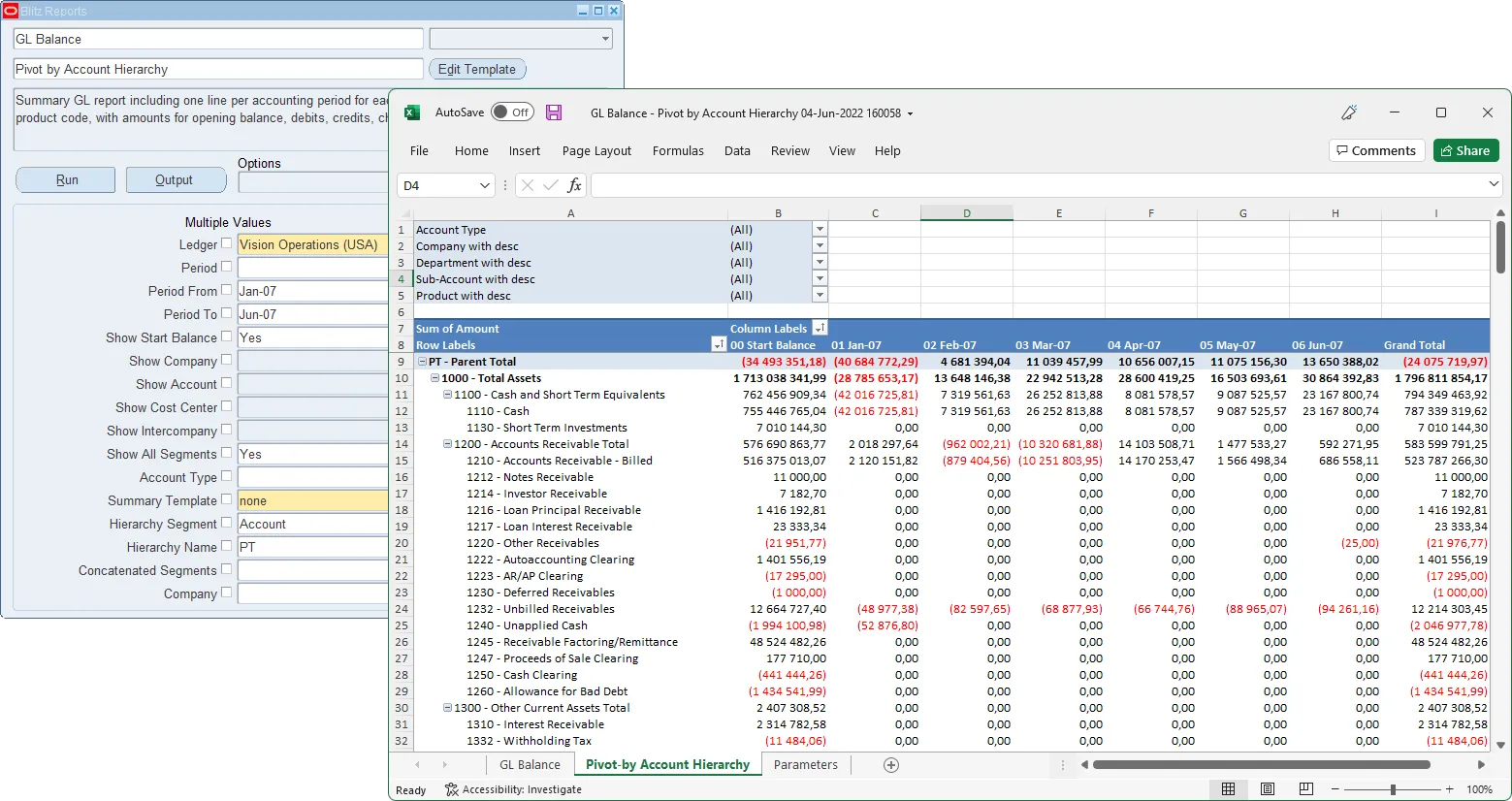
The Filters, Columns, Rows and Values fields are used to create and deliver the data in pivot table format with full drill down to details.
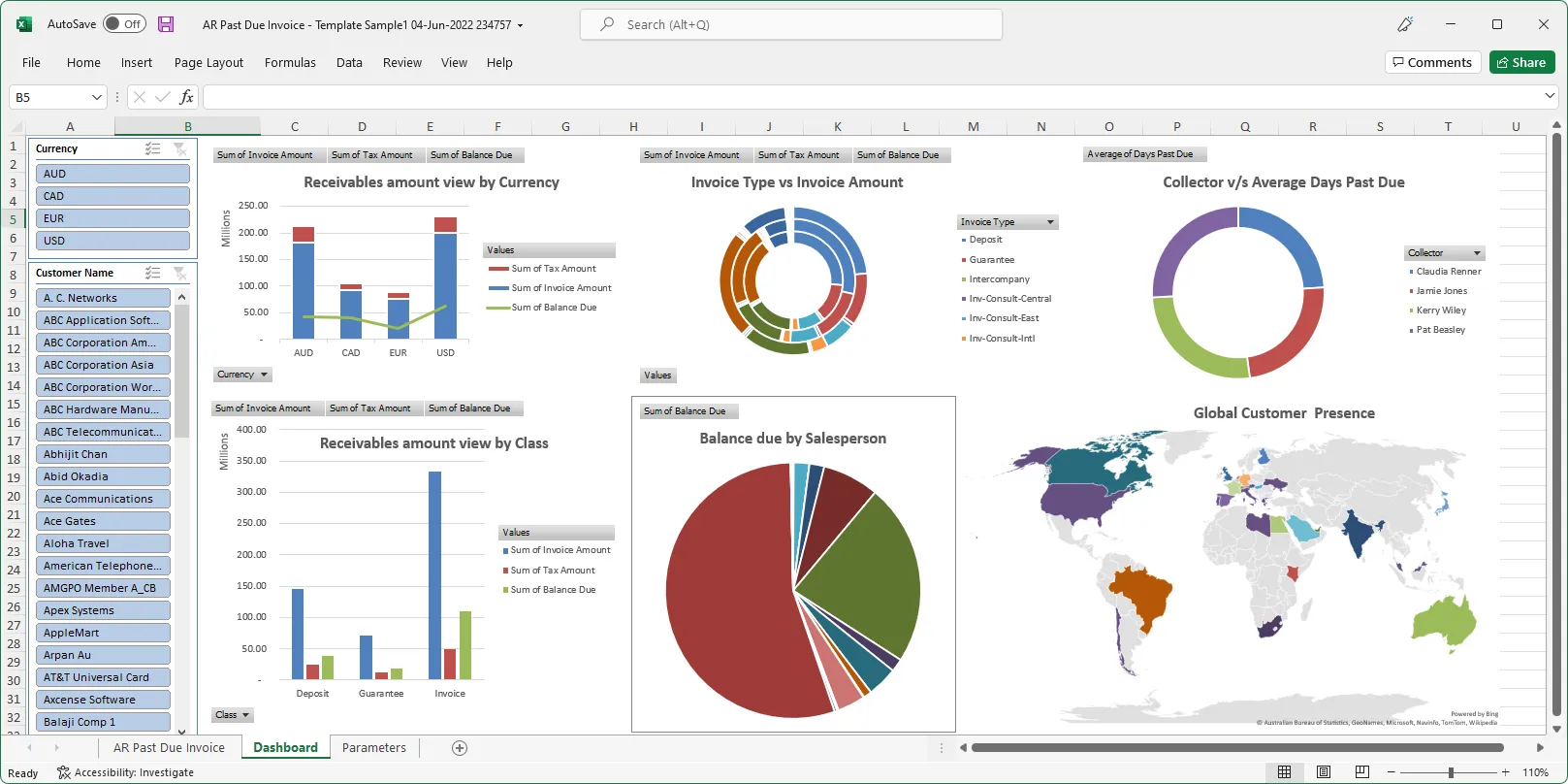
The Excel template upload functionality in Blitz Report allows users to create their own layouts by uploading an Excel template with additional sheets and charts, automatically refreshed when the report runs again. This allows to create custom dashboards and more advanced visualizations of report data.
You can download and use Blitz Report free of charge for your first 30 reports.
The installation and implementation process usually takes less than 1 hour; you can refer to our installation and user guides for specific details.
If you would like to optimize your Oracle EBS implementation and or operational reporting you can visit www.enginatics.com to review great ideas and example usage in blog. Or why not try for yourself in our demo environment.
Useful Links
Blitz Report™ – World’s fastest data upload and reporting for Oracle EBS
Oracle Discoverer replacement – importing worksheets into Blitz Report™
Blitz Report™ Questions & Answers
Supply Chain Hub by Blitz Report™
© 2025 Enginatics