PA Revenue, Cost, Budgets by Resources
Description:
This Blitz Report is the implements the following standard oracle reports.
- MGT: Task - Revenue, Cost, Budgets by Resources
- MGT: Revenue, Cost, Budgets by Resources (Project Level)
The ‘Report Level’ parameter determines if the report is run at the Project Level or Task Level
Report Level Parameter: Project - equivalent to running the MGT: Revenue, Cost, Budgets by Resources (Project Level) report Task - equivalent to running the MGT: Task - Revenue, Cost, Budgets by Resources report
The report has been extended to pull in additional datapoints as displayed in the Project Status Inquiry Form.
Application: Projects Source: MGT: Task - Revenue, Cost, Budgets by Resources (XML) Short Name: PAXMGTSD_XML DB package: PA_PAXMGTSD_XMLP_PKG
Parameters
Operating Unit, Project Organization, Project Manager, Project Number, Project Name, Task Number, Report Level, Cost Budget Type, Revenue Budget Type, Period Name
Used tables
pa_proj_info_view, pa_projects, pa_project_types, pa_proj_invoice_summary_view, hr_all_organization_units_vl, mo_glob_org_access_tmp, dual, pa_project_status_controls, pa_tasks, per_people_x, hr_all_organization_units_tl, pa_project_accum_headers, pa_resource_list_assignments, pa_resource_list_uses, pa_budget_types, pa_resource_list_members, pa_accum_rsrc_act_v, pa_accum_rsrc_cmt_v, pa_accum_rsrc_cost_bgt_v, pa_accum_rsrc_rev_bgt_v, projects, tasks, resource_list, actuals, commitments, budget_revenues, budget_costs
Categories
Dependencies
If you would like to try one of these Oracle EBS SQLs without having Blitz Report installed, note that some of the reports require functions from utility package xxen_util.
Example Report
Report SQL
www.enginatics.com/reports/pa-revenue-cost-budgets-by-resources/
Blitz Report™ import options
PA_Revenue_Cost_Budgets_by_Resources.xml
Case Study & Technical Analysis: PA Revenue, Cost, Budgets by Resources Report
Executive Summary
The PA Revenue, Cost, Budgets by Resources report is a powerful, consolidated financial analysis tool for Oracle Projects. It unifies actual costs, commitments, and budget information at both the project and task levels, broken down by resource. This report, an enhanced implementation of standard Oracle Projects reports, provides project managers, financial analysts, and executives with a critical, real-time view of project performance. It is indispensable for robust financial tracking, proactive management of project profitability, and informed decision-making.
Business Challenge
Effective project financial management requires a clear, holistic understanding of a project’s financial health. However, in standard Oracle Projects, this information is often fragmented and difficult to consolidate:
- Fragmented Financial View: Project financial data (actual costs, open commitments, budget plan, and recognized revenue) resides in different tables and is typically viewed through separate reports or screens, making it challenging to get a single, consolidated picture.
- Lack of Real-time Performance Insight: Without a unified report, project managers often lack immediate insight into how their project is performing against its budget or how commitments are impacting future cash flow.
- Tedious Reporting and Consolidation: Manually extracting and consolidating actuals, budgets, and commitments into spreadsheets for variance analysis is a time-consuming, error-prone process, leading to delayed reporting.
- Difficulty at Different Levels: Analyzing financial performance at both a high project level and a granular task level, broken down by specific resources (e.g., labor, materials), is a complex reporting requirement that standard tools often struggle to meet efficiently.
The Solution
This report provides a dynamic and comprehensive financial dashboard for Oracle Projects, bringing together critical data points for superior project oversight.
- Unified Financial View: It consolidates actual costs, recognized revenue, open commitments, and budget amounts into a single, cohesive report. This allows for immediate variance analysis and a complete understanding of project financial health.
- Flexible Reporting Level: The crucial “Report Level” parameter allows users to switch between a summary view at the Project Level or a detailed breakdown at the Task Level, providing the right granularity of information for different stakeholders.
- Resource-Centric Analysis: By categorizing financial data by resource (e.g., specific job roles, material types), project managers can quickly identify where costs are being incurred, where budget is being consumed, and how resources are impacting profitability.
- Enhanced Project Status Inquiry: Beyond standard report data, it includes additional data points typically found in the Oracle Project Status Inquiry (PSI) form, enriching the analysis and providing a more complete picture of project performance.
Technical Architecture (High Level)
The report is built upon a sophisticated SQL query that integrates data from various Oracle Projects accumulation and budget tables.
- Primary Tables/Views Involved:
pa_projects_allandpa_tasks(for project and task hierarchy details).pa_project_accum_headers(central table for project financial accumulations).pa_accum_rsrc_act_v(view for accumulated actuals by resource).pa_accum_rsrc_cmt_v(view for accumulated commitments by resource).pa_accum_rsrc_cost_bgt_v(view for cost budget by resource).pa_accum_rsrc_rev_bgt_v(view for revenue budget by resource).pa_budget_typesandpa_resource_list_members(for budget type and resource definitions).
- Logical Relationships: The core logic involves joining the project and task structures with the various resource-level accumulation views. These views provide pre-aggregated actual, commitment, cost budget, and revenue budget data. The report then dynamically filters and aggregates this information based on the chosen
Report Level(Project or Task) and specifiedBudget Types.
Parameters & Filtering
The report offers a robust set of parameters for precise data extraction and analysis:
- Organizational Filters:
Operating Unit,Project Organization, andProject Managerallow for drilling down into specific areas of responsibility. - Project/Task Selection:
Project Number,Project Name, andTask Numberenable users to target specific projects or elements within the project hierarchy. - Report Level: The critical parameter to toggle between
Projectsummary andTaskdetail views. - Budget Types:
Cost Budget TypeandRevenue Budget Typeallow for specifying which budget versions should be used for comparison (e.g., ‘Approved Cost Budget’, ‘Forecast’). - Period Name: Enables time-phased analysis for a specific accounting period.
Performance & Optimization
The report is optimized to efficiently handle complex aggregations across multiple financial categories.
- Leveraging Accumulation Tables/Views: The report utilizes Oracle Projects’ pre-accumulated data in views like
pa_accum_rsrc_act_v. This significantly speeds up the retrieval of summed actuals, commitments, and budgets, as the heavy lifting of aggregation is done by Oracle’s processes, not during report execution. - Indexed Joins: The underlying queries are designed to use indexes on project, task, and resource IDs, ensuring fast joins between the various data sources.
- Controlled Data Volume: Parameters like
Project NumberandPeriod Nameallow users to limit the scope of the report, preventing it from attempting to process an excessively large dataset when detailed analysis is not required.
FAQ
1. What is the difference between “Actual Costs” and “Commitments”? “Actual Costs” represent expenditures that have already been incurred and posted to the General Ledger (e.g., an approved supplier invoice or employee timesheet). “Commitments” represent future obligations or planned expenditures that have not yet become actuals (e.g., a purchase order that has been approved but not yet invoiced). This report allows you to view both for a holistic financial picture.
2. How does the report determine which “Budget Type” to display?
The report uses the Cost Budget Type and Revenue Budget Type parameters. Users typically define different budget types (e.g., “Approved Budget,” “Working Budget,” “Forecast 1,” “Forecast 2”) to track different versions of their financial plans. The report allows you to select which specific budget version to compare against actuals and commitments.
3. Can this report show variance between budget and actuals? Yes, by showing budget amounts alongside actual costs and recognized revenue, the report inherently facilitates variance analysis. Users can easily export the data to Excel to calculate and visualize variances by resource, task, or project, and investigate where deviations from the plan are occurring.
Oracle E-Business Suite Reporting Library
We provide an open source Oracle EBS SQLs as a part of operational and project implementation support toolkits for rapid Excel reports generation.
Blitz Report™ is based on Oracle EBS forms technology, and hence requires minimal training. There are no data or performance limitations since the output files are created directly from the database without going through intermediate file formats such as XML.
Blitz Report can be used as BI Publisher and Oracle Discoverer replacement tool. Standard Oracle BI Publisher and Discoverer reports can also be imported into Blitz Report for immediate output to Excel. Typically, reports can be created and version tracked within hours instead of days. The concurrent request output automatically opens upon completion without the need for re-formatting.
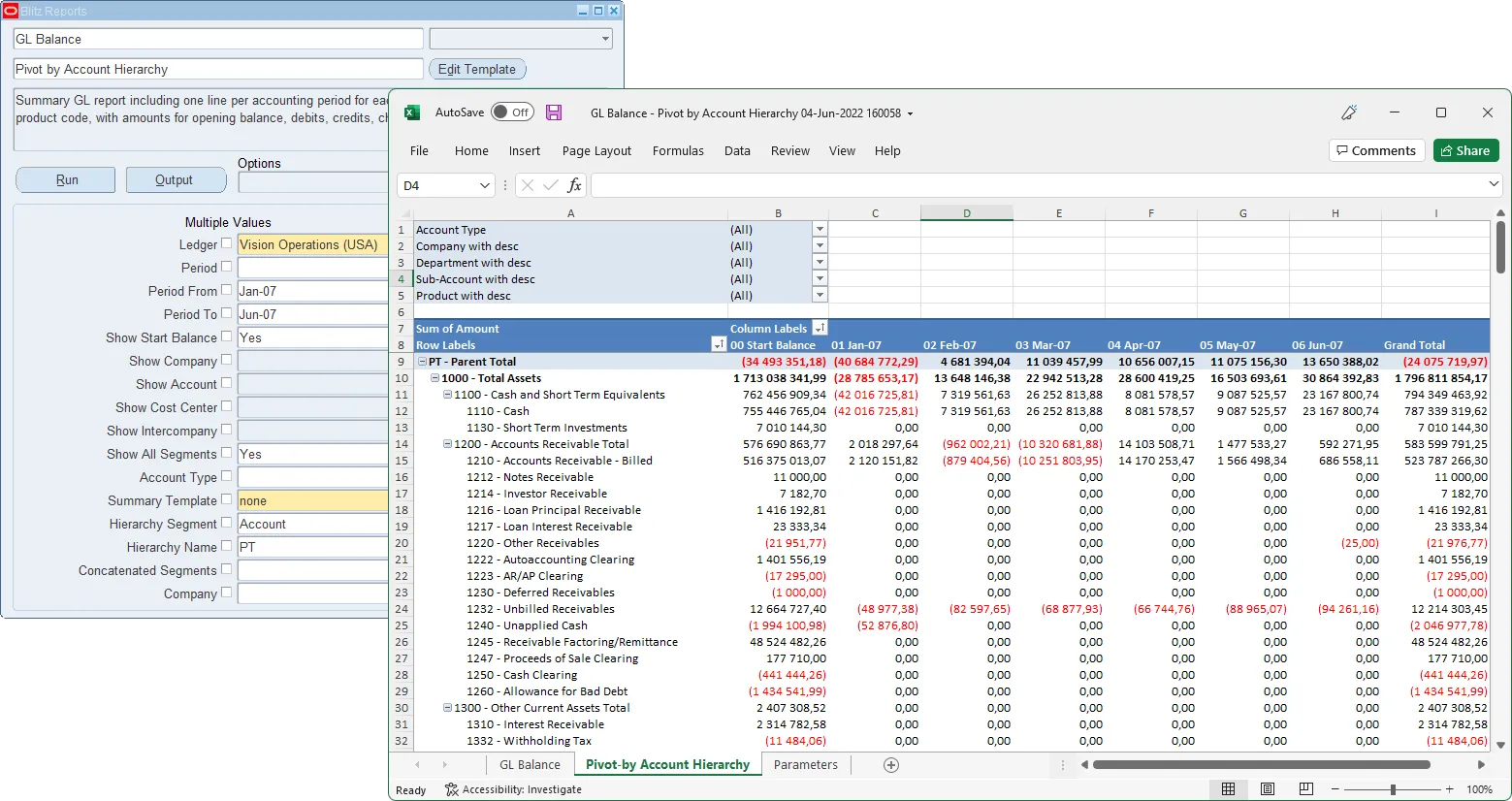
The Filters, Columns, Rows and Values fields are used to create and deliver the data in pivot table format with full drill down to details.
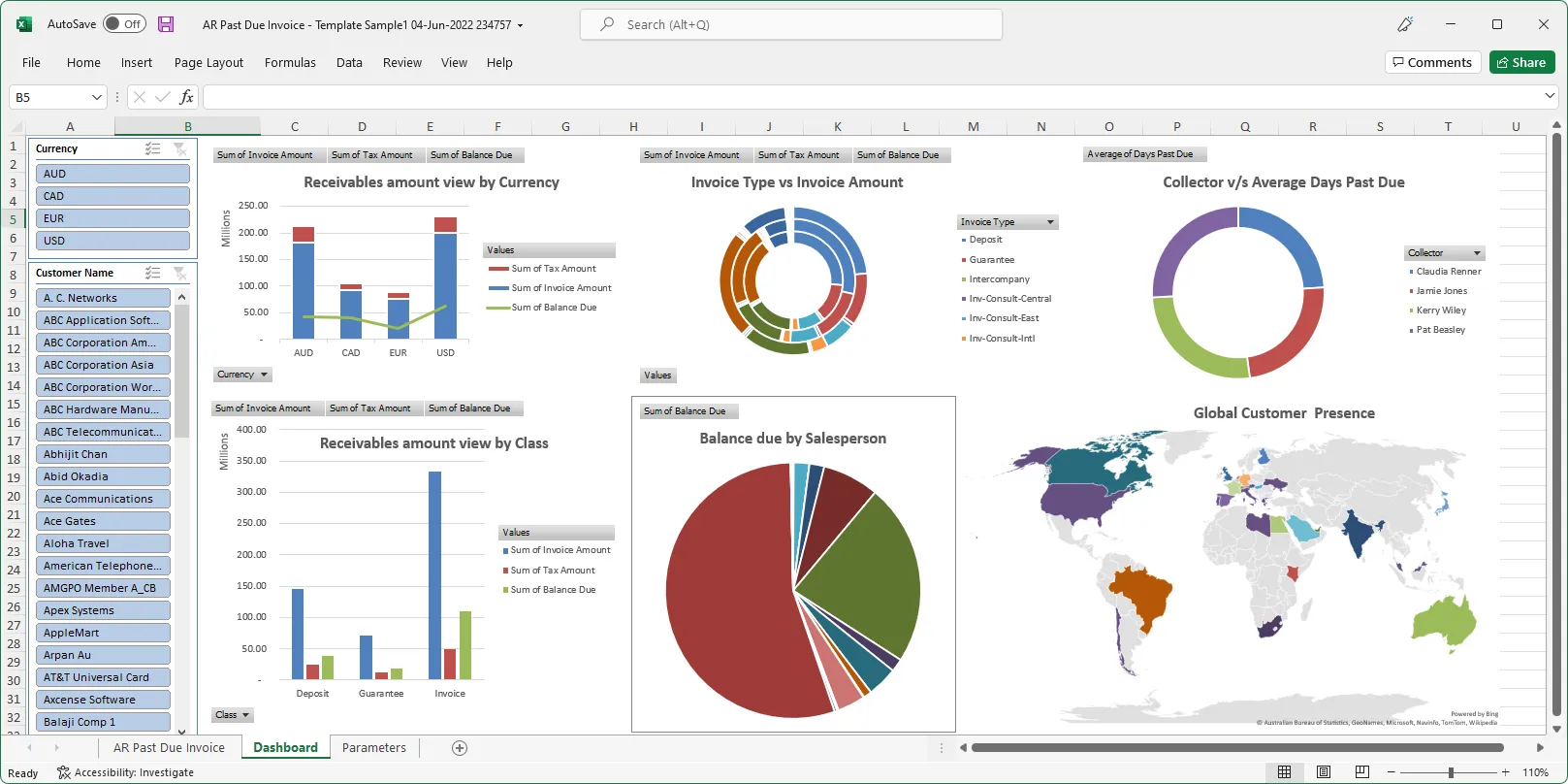
The Excel template upload functionality in Blitz Report allows users to create their own layouts by uploading an Excel template with additional sheets and charts, automatically refreshed when the report runs again. This allows to create custom dashboards and more advanced visualizations of report data.
You can download and use Blitz Report free of charge for your first 30 reports.
The installation and implementation process usually takes less than 1 hour; you can refer to our installation and user guides for specific details.
If you would like to optimize your Oracle EBS implementation and or operational reporting you can visit www.enginatics.com to review great ideas and example usage in blog. Or why not try for yourself in our demo environment.
Useful Links
Blitz Report™ – World’s fastest data upload and reporting for Oracle EBS
Oracle Discoverer replacement – importing worksheets into Blitz Report™
Blitz Report™ Questions & Answers
Supply Chain Hub by Blitz Report™
© 2025 Enginatics