PAY Employee Payroll History
Description:
Master data report with one line per employee including employee number, name, payroll period and earnings.
Parameters
Last Name starts with, Business Group, Payroll Run Date From, Payroll Run Date To, Effective Date
Used tables
hr_all_organization_units_vl, per_all_people_f, per_all_assignments_f, pay_assignment_actions, pay_payroll_actions, pay_run_results, pay_run_result_values, pay_element_types_f, pay_input_values_f, per_time_periods, pay_element_classifications_vl
Categories
Dependencies
If you would like to try one of these Oracle EBS SQLs without having Blitz Report installed, note that some of the reports require functions from utility package xxen_util.
Example Report
Report SQL
www.enginatics.com/reports/pay-employee-payroll-history/
Blitz Report™ import options
PAY_Employee_Payroll_History.xml
Case Study & Technical Analysis: PAY Employee Payroll History Report
Executive Summary
The PAY Employee Payroll History report is a comprehensive master data report that provides a detailed history of payroll earnings and deductions for each employee within Oracle Payroll. It consolidates critical information such as employee number, name, payroll period, and a breakdown of earnings elements. This report is an indispensable tool for human resources, payroll administrators, and financial auditors who require a clear, auditable trail of an employee’s compensation over time, ensuring accuracy in financial records and supporting employee inquiries.
Business Challenge
Managing and verifying employee payroll history in a large organization can be a complex and time-consuming task. Standard Oracle forms provide transactional details but often lack a consolidated, easily accessible historical view. Key challenges include:
- Fragmented Data Access: Information about an employee’s earnings and deductions over multiple payroll periods is typically scattered across various screens and reports, making it difficult to get a holistic historical view.
- Manual Reconciliation and Verification: Responding to employee inquiries about past pay, verifying historical earnings for loan applications, or auditing payroll calculations often involves manually piecing together data from different sources, which is inefficient and prone to errors.
- Compliance and Audit Readiness: For internal and external audits, a clear and comprehensive record of employee payroll history is mandatory. Generating this information in an easily consumable format can be a significant challenge.
- Trend Analysis Limitations: Without a consolidated historical view, identifying trends in employee compensation (e.g., changes in overtime, bonuses) or analyzing the impact of pay raises over time is difficult.
The Solution
This report provides a consolidated, detailed, and easily accessible view of employee payroll history, transforming how organizations manage and audit compensation data.
- Comprehensive Historical View: It presents a single line per employee for each payroll period, detailing all earnings and, if configured, deductions. This offers an immediate and complete picture of an employee’s compensation over any selected timeframe.
- Streamlined Query and Audit: With intuitive filtering parameters, HR and payroll staff can quickly retrieve specific employee histories, verify calculations, and provide accurate responses to inquiries, significantly reducing response times and improving service.
- Enhanced Compliance: The report generates an auditable record of payroll data, making it easier for organizations to demonstrate compliance with labor laws, tax regulations, and internal policies.
- Supports Compensation Analysis: By providing historical earnings data, the report serves as a valuable input for HR analysts to perform compensation trend analysis, evaluate the effectiveness of pay structures, and support workforce planning.
Technical Architecture (High Level)
The report queries core Oracle HR and Payroll tables, joining historical payroll run results with employee and assignment details.
- Primary Tables Involved:
per_all_people_f(for core employee demographic data like name and employee number).per_all_assignments_f(for employee assignment details, including business group).pay_payroll_actions(the header for each payroll run).pay_assignment_actions(links specific assignments to payroll runs).pay_run_resultsandpay_run_result_values(contain the detailed earnings and deduction values for each payroll element).pay_element_types_fandpay_input_values_f(for defining payroll elements).per_time_periods(for payroll period details).
- Logical Relationships: The report starts by identifying employees and their assignments. It then links these to completed payroll actions and subsequently drills down to the
pay_run_resultsandpay_run_result_valuestables to extract the actual calculated amounts for each earning and deduction element processed during a specific payroll period.
Parameters & Filtering
The report offers flexible parameters for targeted historical analysis:
- Employee Identification:
Last Name starts withprovides a wildcard search capability, and specificEmployeenumbers can be entered. - Organizational Context:
Business Groupallows filtering for specific legal entities or organizations. - Date Ranges:
Payroll Run Date FromandPayroll Run Date Toare crucial for specifying the historical period to be analyzed. AnEffective Dateparameter may also be used for point-in-time analysis.
Performance & Optimization
As a report dealing with potentially large volumes of historical payroll data, it is optimized through efficient filtering.
- Date and Employee Filters: The primary filters (
Payroll Run Date From/To,Last Name starts with) are critical for narrowing the data set. Effective use of these parameters allows the database to quickly access relevant payroll history using existing indexes. - Targeted Data Retrieval: The report focuses on extracting summarized earnings information per employee per period, avoiding the need to process excessively granular data unless explicitly required.
FAQ
1. Can this report show details of specific deductions, not just earnings? Yes, if configured, the report can be extended to include details of specific deduction elements, such as health insurance premiums or 401k contributions, by joining to the relevant tables that store these run results.
2. How does the report handle employees with multiple assignments? The report is typically designed to show one line per employee assignment per payroll period. If an employee has multiple active assignments within the same payroll period, there would be a separate line for each assignment’s earnings and deductions.
3. Is this report suitable for generating year-to-date (YTD) earnings statements? While this report provides historical detail, its primary purpose is usually for analysis and auditing rather than generating official YTD statements. For official statements, standard Oracle statutory reports or customized pay slips are generally used, as they often include specific formatting and aggregated YTD totals.
Oracle E-Business Suite Reporting Library
We provide an open source Oracle EBS SQLs as a part of operational and project implementation support toolkits for rapid Excel reports generation.
Blitz Report™ is based on Oracle EBS forms technology, and hence requires minimal training. There are no data or performance limitations since the output files are created directly from the database without going through intermediate file formats such as XML.
Blitz Report can be used as BI Publisher and Oracle Discoverer replacement tool. Standard Oracle BI Publisher and Discoverer reports can also be imported into Blitz Report for immediate output to Excel. Typically, reports can be created and version tracked within hours instead of days. The concurrent request output automatically opens upon completion without the need for re-formatting.
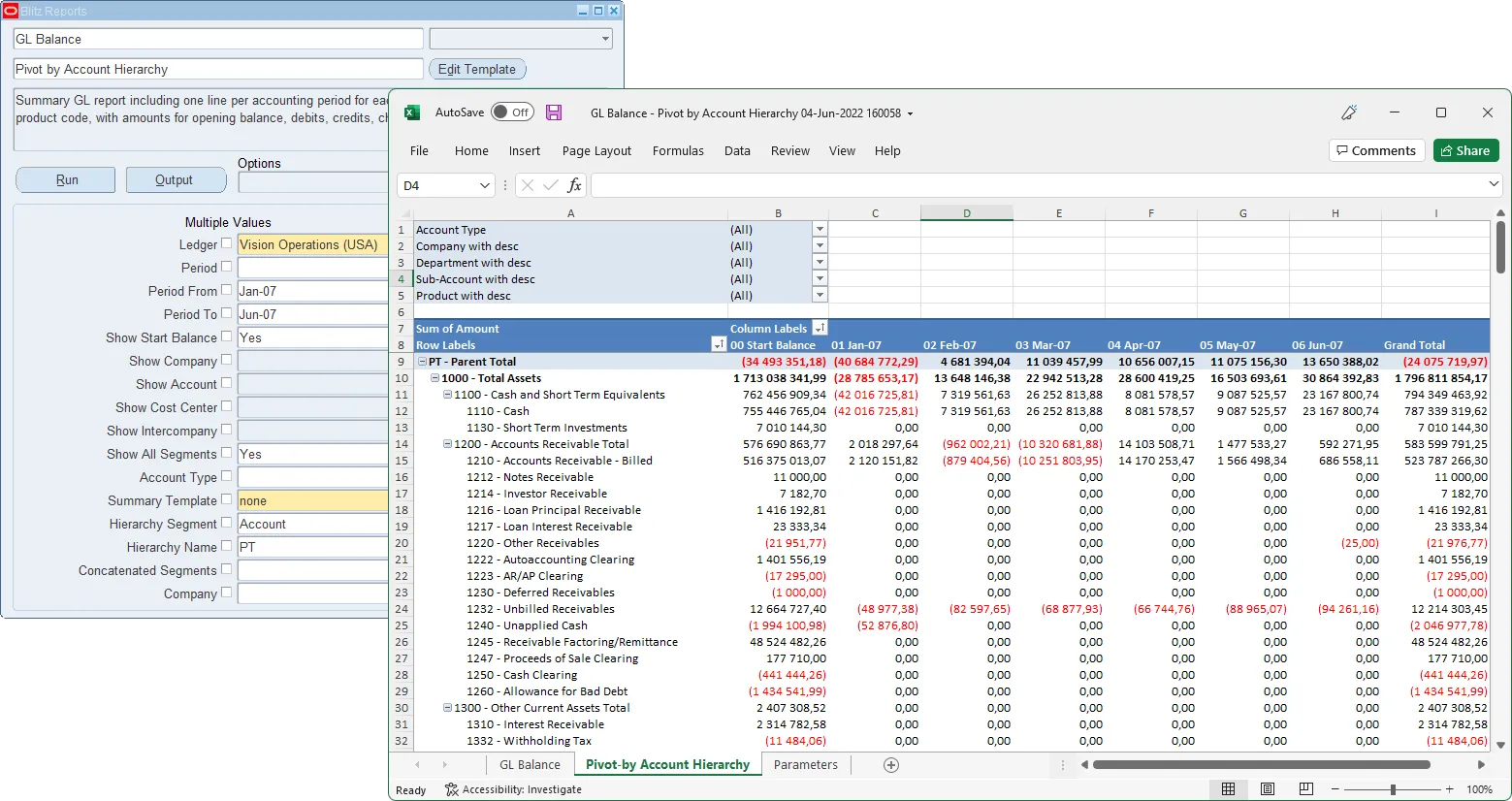
The Filters, Columns, Rows and Values fields are used to create and deliver the data in pivot table format with full drill down to details.
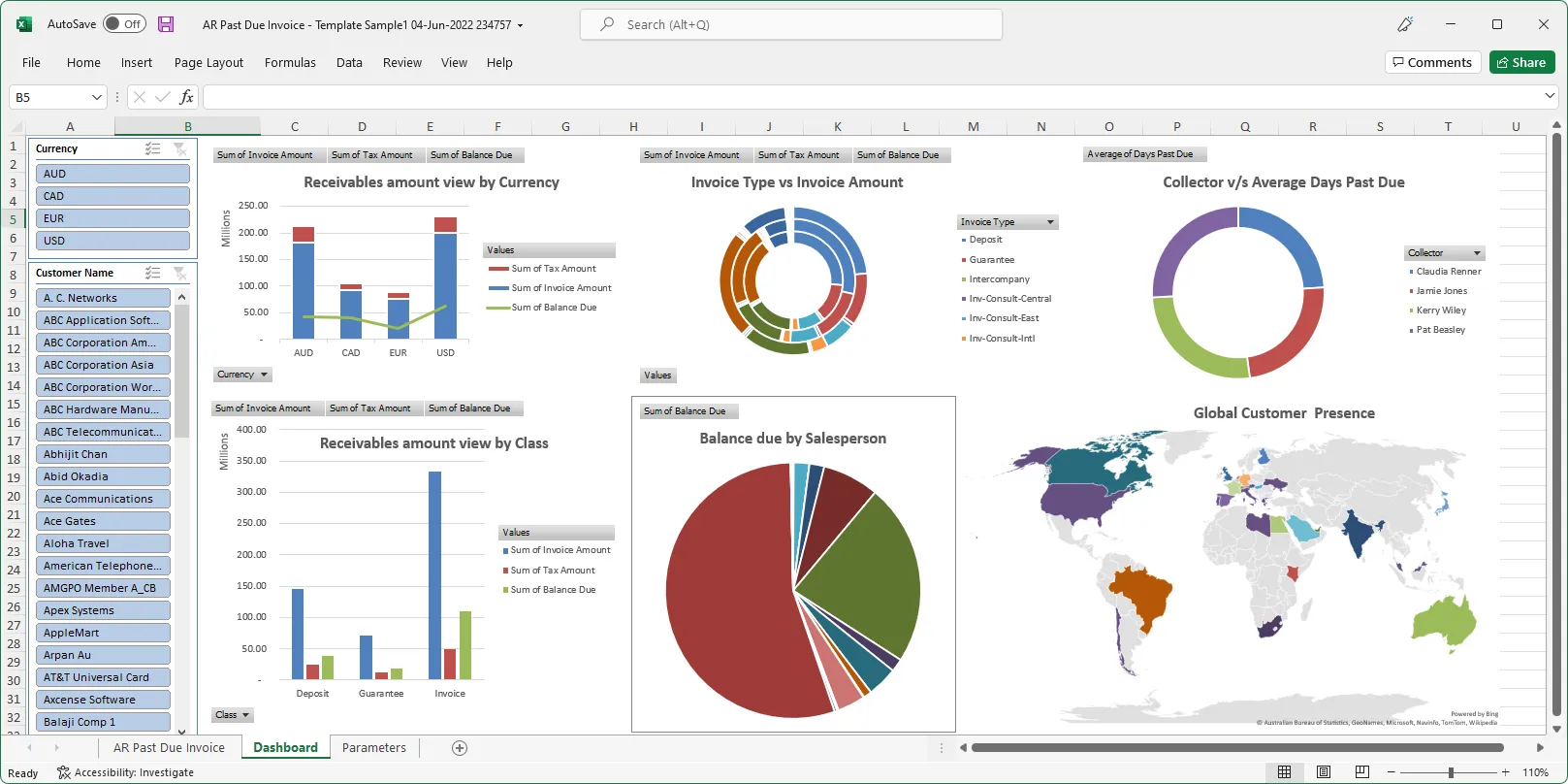
The Excel template upload functionality in Blitz Report allows users to create their own layouts by uploading an Excel template with additional sheets and charts, automatically refreshed when the report runs again. This allows to create custom dashboards and more advanced visualizations of report data.
You can download and use Blitz Report free of charge for your first 30 reports.
The installation and implementation process usually takes less than 1 hour; you can refer to our installation and user guides for specific details.
If you would like to optimize your Oracle EBS implementation and or operational reporting you can visit www.enginatics.com to review great ideas and example usage in blog. Or why not try for yourself in our demo environment.
Useful Links
Blitz Report™ – World’s fastest data upload and reporting for Oracle EBS
Oracle Discoverer replacement – importing worksheets into Blitz Report™
Blitz Report™ Questions & Answers
Supply Chain Hub by Blitz Report™
© 2025 Enginatics