PER Organization Hierarchy
Description:
Master data report showing hierarchical list of human resource organization structures including subordinate orgs.
Parameters
Business Group, Hierarchy Name, Top Level Organization
Used tables
hr_organization_information, per_organization_structures, per_org_structure_versions, hr_all_organization_units_vl, per_org_structure_elements, per_all_assignments_f, per_business_groups
Categories
Dependencies
If you would like to try one of these Oracle EBS SQLs without having Blitz Report installed, note that some of the reports require functions from utility package xxen_util.
Example Report
PER Organization Hierarchy 29-Jan-2020 051446.xlsx
Report SQL
www.enginatics.com/reports/per-organization-hierarchy/
Blitz Report™ import options
PER_Organization_Hierarchy.xml
Case Study & Technical Analysis: PER Organization Hierarchy Report
Executive Summary
The PER Organization Hierarchy report is a critical Human Resources master data report that provides a detailed, hierarchical listing of an organization’s structure within Oracle HR. It displays the reporting relationships between organizations, including subordinate entities, allowing HR professionals, managers, and executives to visualize and analyze the company’s structural framework. This report is indispensable for understanding reporting lines, supporting organizational design initiatives, and ensuring accurate HR data management for various HR functions like payroll, benefits, and talent management.
Business Challenge
Understanding and maintaining an accurate organizational hierarchy is fundamental for effective HR and business operations. Organizations often face significant challenges in managing this complex structure within Oracle EBS:
- Visualizing Complex Structures: Large enterprises have intricate organizational structures that are difficult to visualize and comprehend using standard Oracle forms, which typically show one organization at a time.
- Maintaining Data Accuracy: Organizational changes (mergers, new departments, restructuring) are frequent. Ensuring that the HR system accurately reflects the current and historical hierarchies is a continuous and often manual challenge.
- Impact on Downstream Processes: The organizational hierarchy impacts numerous HR and financial processes, including security, approvals, reporting, and payroll. Inaccurate hierarchies can lead to incorrect data visibility, approval bottlenecks, or misallocated costs.
- Reporting and Analysis: Generating reports based on organizational structure (e.g., headcount by department, cost by business unit) is a common requirement, but often requires specialized reporting tools or manual data manipulation.
The Solution
This report provides a clear, hierarchical, and easily auditable view of the organizational structure, directly addressing the complexities of managing enterprise hierarchies.
- Hierarchical Visualization: It presents the organizational structure in a clear, indented format, making it easy to understand reporting lines and the relationships between parent and child organizations.
- Accurate Structural Data: By extracting data directly from Oracle HR’s core organization setup tables, the report provides a reliable source of truth for the current and historical organizational structure.
- Supports Strategic HR: HR managers and executives can use this report for workforce planning, reorganizational design, and analyzing the impact of structural changes on staffing and costs.
- Enhanced Compliance and Audit: The report serves as vital documentation for internal and external audits, demonstrating how the organization is structured for various compliance and operational purposes.
Technical Architecture (High Level)
The report queries core Oracle HR tables that define organizational structures and their hierarchical relationships.
- Primary Tables Involved:
per_organization_structures(defines the overall organizational structure).per_org_structure_versions(stores different versions of an organizational structure, allowing for historical views).per_org_structure_elements(the critical table that defines the parent-child relationships between organizations within a hierarchy).hr_all_organization_units_vl(for the names and details of individual organizations).per_business_groups(for overall business group context).
- Logical Relationships: The report begins by identifying a specific
Hierarchy Nameand its activeVersion. It then traverses theper_org_structure_elementstable, starting from aTop Level Organization, to recursively build the hierarchy. For each organization in the hierarchy, it retrieves its details fromhr_all_organization_units_vl.
Parameters & Filtering
The report offers flexible parameters for targeted analysis of the organizational hierarchy:
- Business Group: Filters the report to a specific legal entity or organizational grouping.
- Hierarchy Name: Allows users to select a specific organizational hierarchy (e.g., ‘Departmental Hierarchy’, ‘Legal Entity Hierarchy’) if multiple structures are defined.
- Top Level Organization: A crucial parameter that allows users to view the hierarchy starting from a specific parent organization down, rather than the entire enterprise structure. This is vital for managers focused on their specific span of control.
Performance & Optimization
As a master data report dealing with hierarchical structures, it is optimized by its ability to limit the scope of the query.
- Hierarchy-Driven Retrieval: The parameters
Hierarchy NameandTop Level Organizationare crucial for performance. By specifying a subset of the hierarchy, the database can efficiently traverse theper_org_structure_elementstable to build the requested structure. - Indexed Relationships: The underlying tables are typically indexed on parent-child relationships (e.g.,
organization_id_parent,organization_id_child), allowing for quick traversal of the hierarchy.
FAQ
1. What is the difference between an ‘Organization’ and an ‘Organization Hierarchy’? An ‘Organization’ (e.g., “Sales Department,” “Manufacturing Plant”) is a distinct entity within Oracle HR. An ‘Organization Hierarchy’ is a defined structure that links these individual organizations together in a parent-child relationship, showing reporting lines or functional groupings across the enterprise.
2. Can this report show all employees within each organization in the hierarchy?
This report focuses on the organizational structure itself. While related to employee data, it does not typically show individual employees within each organization. A separate report, possibly joining PER Employee Assignments with this hierarchy, would be needed for that level of detail.
3. Why would an organization have multiple hierarchies? Organizations may have multiple hierarchies for different purposes. For example, a company might have a ‘Line Management Hierarchy’ for reporting lines, a ‘Legal Entity Hierarchy’ for financial consolidation, and a ‘Cost Center Hierarchy’ for expense allocation. This report allows you to view any of these defined structures.
Oracle E-Business Suite Reporting Library
We provide an open source Oracle EBS SQLs as a part of operational and project implementation support toolkits for rapid Excel reports generation.
Blitz Report™ is based on Oracle EBS forms technology, and hence requires minimal training. There are no data or performance limitations since the output files are created directly from the database without going through intermediate file formats such as XML.
Blitz Report can be used as BI Publisher and Oracle Discoverer replacement tool. Standard Oracle BI Publisher and Discoverer reports can also be imported into Blitz Report for immediate output to Excel. Typically, reports can be created and version tracked within hours instead of days. The concurrent request output automatically opens upon completion without the need for re-formatting.
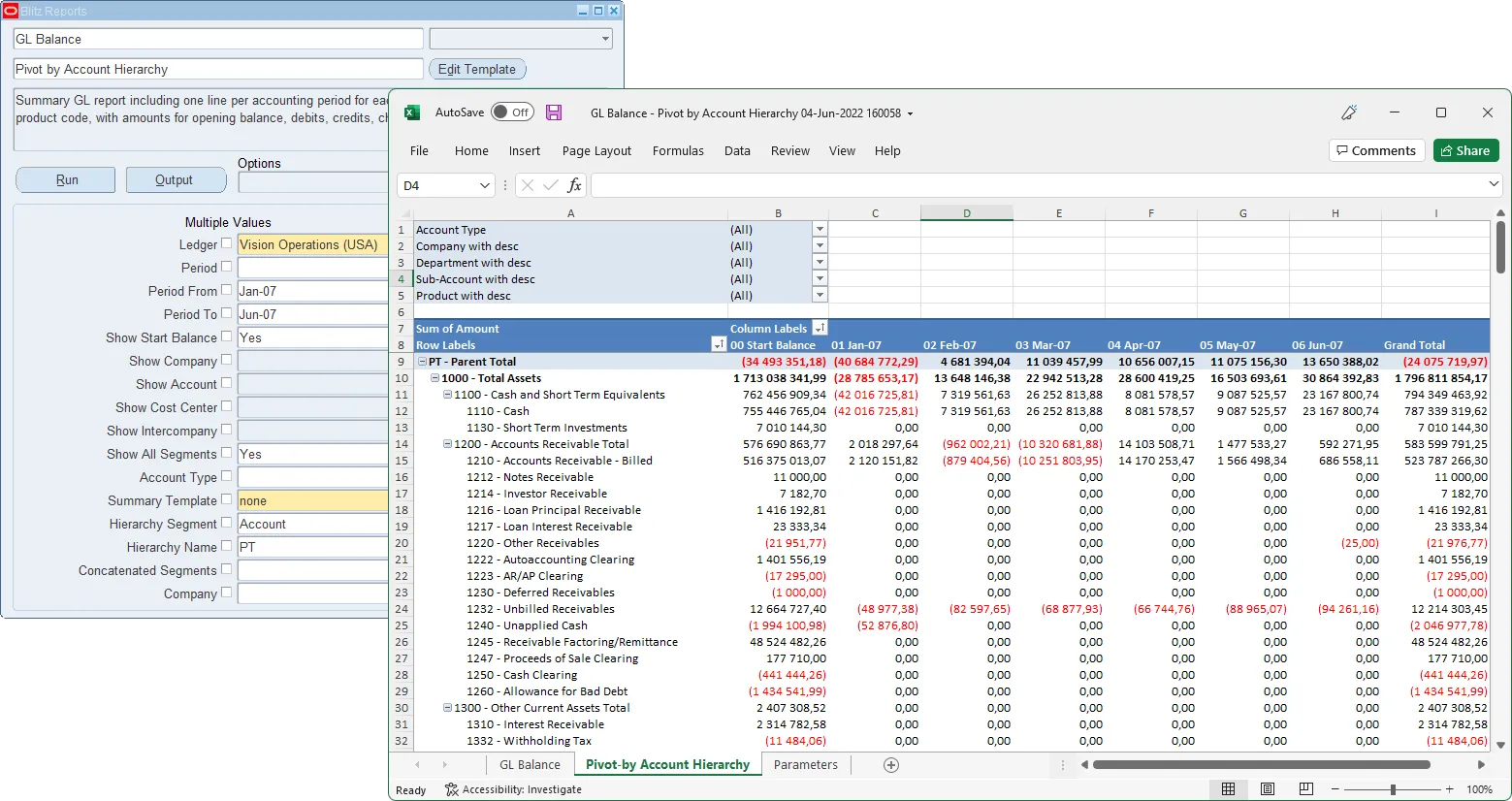
The Filters, Columns, Rows and Values fields are used to create and deliver the data in pivot table format with full drill down to details.
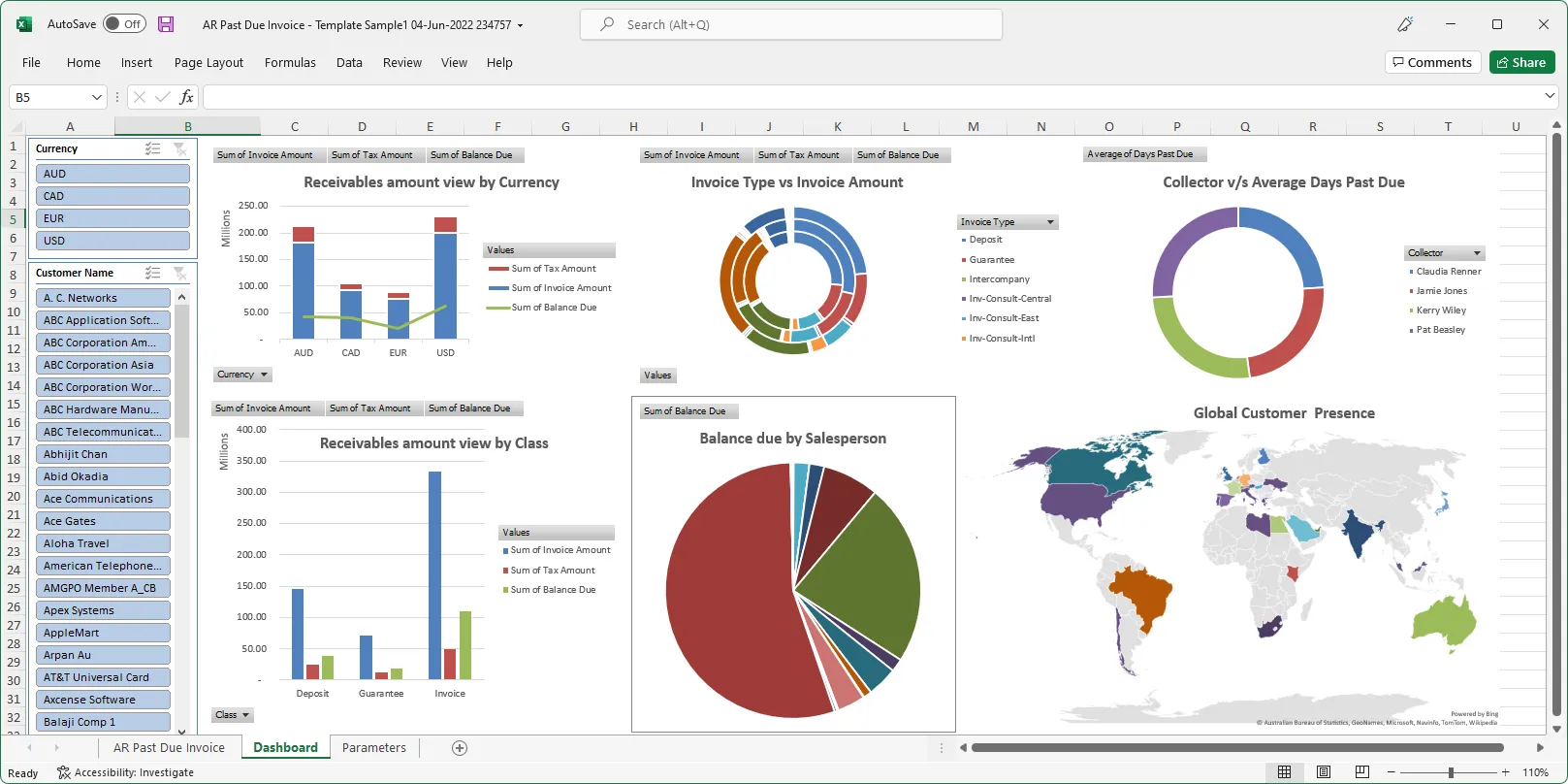
The Excel template upload functionality in Blitz Report allows users to create their own layouts by uploading an Excel template with additional sheets and charts, automatically refreshed when the report runs again. This allows to create custom dashboards and more advanced visualizations of report data.
You can download and use Blitz Report free of charge for your first 30 reports.
The installation and implementation process usually takes less than 1 hour; you can refer to our installation and user guides for specific details.
If you would like to optimize your Oracle EBS implementation and or operational reporting you can visit www.enginatics.com to review great ideas and example usage in blog. Or why not try for yourself in our demo environment.
Useful Links
Blitz Report™ – World’s fastest data upload and reporting for Oracle EBS
Oracle Discoverer replacement – importing worksheets into Blitz Report™
Blitz Report™ Questions & Answers
Supply Chain Hub by Blitz Report™
© 2025 Enginatics