PN GL Reconciliation
Description:
Application: Property Manager Report: PN GL Reconciliation
Parameters
Ledger, Operating Unit, Period, Representation, Regime, Lease Number, Lease Number From, Lease Number To, Lease Name, Lease Name From, Lease Name To, Show Amt in Ledger/Entered Currency, Incl Revenue/Expense Accounts, Incl Amt by Term/Option Type, Incl Amt by Stream Type, Incl Amt by SLA Account Class, Incl Amt by SLA Account Segment, Incl Manual GL Entries
Used tables
xmltable, xla_entity_types_vl, xla_event_types_vl, q_trx, q_trx_amt
Categories
Related reports
Dependencies
If you would like to try one of these Oracle EBS SQLs without having Blitz Report installed, note that some of the reports require functions from utility package xxen_util.
Example Report
Report SQL
www.enginatics.com/reports/pn-gl-reconciliation/
Blitz Report™ import options
Case Study & Technical Analysis: PN GL Reconciliation Report
Executive Summary
The PN GL Reconciliation report is a crucial financial closing and audit tool for organizations using Oracle Property Management (PN). It facilitates the vital process of reconciling lease-related subledger activity with the corresponding account balances in the General Ledger. This report provides a detailed breakdown of Property Management transactions, enabling finance teams to identify and investigate any discrepancies, ensure the accuracy of financial statements, and comply with accounting standards for lease assets and liabilities.
Business Challenge
Reconciling subledger balances to the General Ledger is a fundamental aspect of financial reporting, but it can be particularly complex for specialized modules like Property Management. Key challenges include:
- Subledger-to-GL Discrepancies: It is a common and serious issue for the detailed financial activity recorded in the Property Management subledger (e.g., rent revenue, lease expense) to become out of sync with the balances posted to the General Ledger.
- Lack of Detailed Reconciliation Tools: Standard Oracle reports often lack the granularity or flexibility needed to easily compare PN subledger data with GL balances, especially when trying to pinpoint the source of variances.
- Impact of Lease Accounting Standards: With new lease accounting standards (ASC 842, IFRS 16), the volume and complexity of lease-related financial entries have increased, making reconciliation even more critical and challenging.
- Manual Investigation Effort: Investigating PN-to-GL discrepancies often involves labor-intensive manual data extraction and comparison across multiple systems, leading to delays in the financial close and increased audit risk.
The Solution
This report provides an automated, detailed, and configurable reconciliation that transforms the PN financial close process.
- Automated Balance Comparison: The report automatically compares financial activity originating from Property Management to the corresponding GL account balances, highlighting any differences.
- Granular Variance Identification: It offers extensive options to break down amounts by term/option type, stream type, SLA account class, and even SLA account segments, allowing finance teams to pinpoint the exact source of any discrepancy.
- Inclusion of Manual GL Entries: The option to include manual GL entries helps in identifying if out-of-balance situations are caused by journal entries made directly to PN-related accounts, bypassing the subledger.
- Accelerated Financial Close: By providing a structured and detailed reconciliation, the report significantly reduces the time and effort required for month-end close, improving the timeliness and reliability of financial reporting.
Technical Architecture (High Level)
The report queries core Oracle Property Management and Subledger Accounting (SLA) tables to provide a comprehensive reconciliation view.
- Primary Tables Involved:
pn_leases_allandpn_payment_terms_all(to identify lease contracts and their associated financial terms).xla_ae_headersandxla_ae_lines(Subledger Accounting tables that store the detailed accounting entries generated from Property Management transactions before they are posted to the GL).gl_je_headersandgl_je_lines(for General Ledger journal entry details).xla_entity_types_vlandxla_event_types_vl(for definitions of SLA entities and event types).q_trxandq_trx_amt(likely internal views or temporary tables used to process transaction and amount details for reconciliation).
- Logical Relationships: The report links Property Management lease and payment term data to the corresponding accounting entries generated in SLA. It then compares these subledger entries against the actual postings in the General Ledger. The various “Incl Amt by” parameters determine how these amounts are aggregated and presented for comparison.
Parameters & Filtering
The report offers a highly flexible set of parameters for granular reconciliation:
- Financial Context:
Ledger,Operating Unit, andPeriodare critical for defining the scope of the reconciliation. - Lease Identification:
Lease NumberandLease Name(withFrom/Toranges) allow for specific lease-level reconciliation. - Amount Breakdown Options: A wide array of “Incl Amt by” parameters (
Term/Option Type,Stream Type,SLA Account Class,SLA Account Segment) allows users to customize the report’s detail level for targeted discrepancy analysis. - Incl Manual GL Entries: A crucial parameter to help pinpoint if manual adjustments in the GL are causing reconciliation issues.
Performance & Optimization
As a detailed financial reconciliation report, it is optimized through period-driven filtering and efficient aggregation of subledger data.
- Period-Driven Processing: The
Periodparameter is essential for performance. It allows the report to focus on a specific accounting period’s activity, preventing the need to process all historical transaction data. - Leveraging SLA Data: By querying the Subledger Accounting tables (
xla_*), the report benefits from Oracle’s robust accounting engine, which pre-processes and structures transactional data for GL posting, allowing for more efficient reconciliation queries. - Conditional Data Inclusion: The various
Incl Amt byparameters allow the report to execute more complex aggregation logic only when that specific level of detail is requested, preventing unnecessary processing.
FAQ
1. What are the most common reasons for a discrepancy between Property Management and the General Ledger? Common reasons include: unposted transactions in PN, errors in Subledger Accounting (SLA) setups, manual journal entries made directly to PN-related GL accounts (bypassing the subledger), or data integrity issues. This report helps pinpoint where these issues might lie.
2. How does the ‘Regime’ parameter impact the report?
The Regime parameter refers to the accounting standard or rule set (ee.g., “US GAAP,” “IFRS”) under which the accounting entries are generated. If your organization uses different accounting regimes, this parameter allows you to reconcile transactions processed under a specific set of rules.
3. What is the benefit of including ‘Manual GL Entries’ in the report? Including manual GL entries (those not originating from Property Management) is critical for reconciliation. If there’s a discrepancy, and you see manual entries to a PN-related GL account, it immediately flags a potential issue where the GL was adjusted without the subledger being updated, or vice-versa.
Oracle E-Business Suite Reporting Library
We provide an open source Oracle EBS SQLs as a part of operational and project implementation support toolkits for rapid Excel reports generation.
Blitz Report™ is based on Oracle EBS forms technology, and hence requires minimal training. There are no data or performance limitations since the output files are created directly from the database without going through intermediate file formats such as XML.
Blitz Report can be used as BI Publisher and Oracle Discoverer replacement tool. Standard Oracle BI Publisher and Discoverer reports can also be imported into Blitz Report for immediate output to Excel. Typically, reports can be created and version tracked within hours instead of days. The concurrent request output automatically opens upon completion without the need for re-formatting.
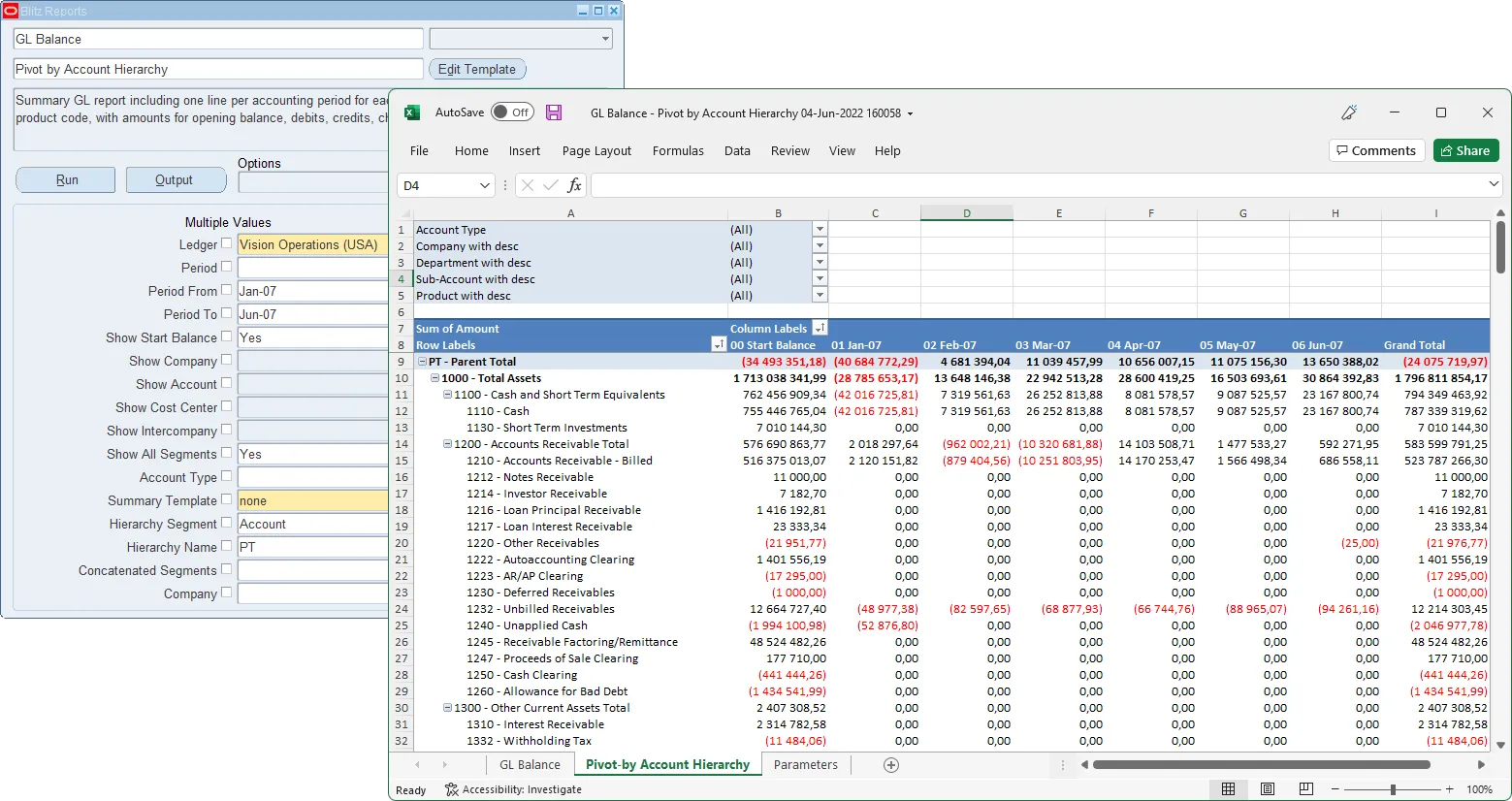
The Filters, Columns, Rows and Values fields are used to create and deliver the data in pivot table format with full drill down to details.
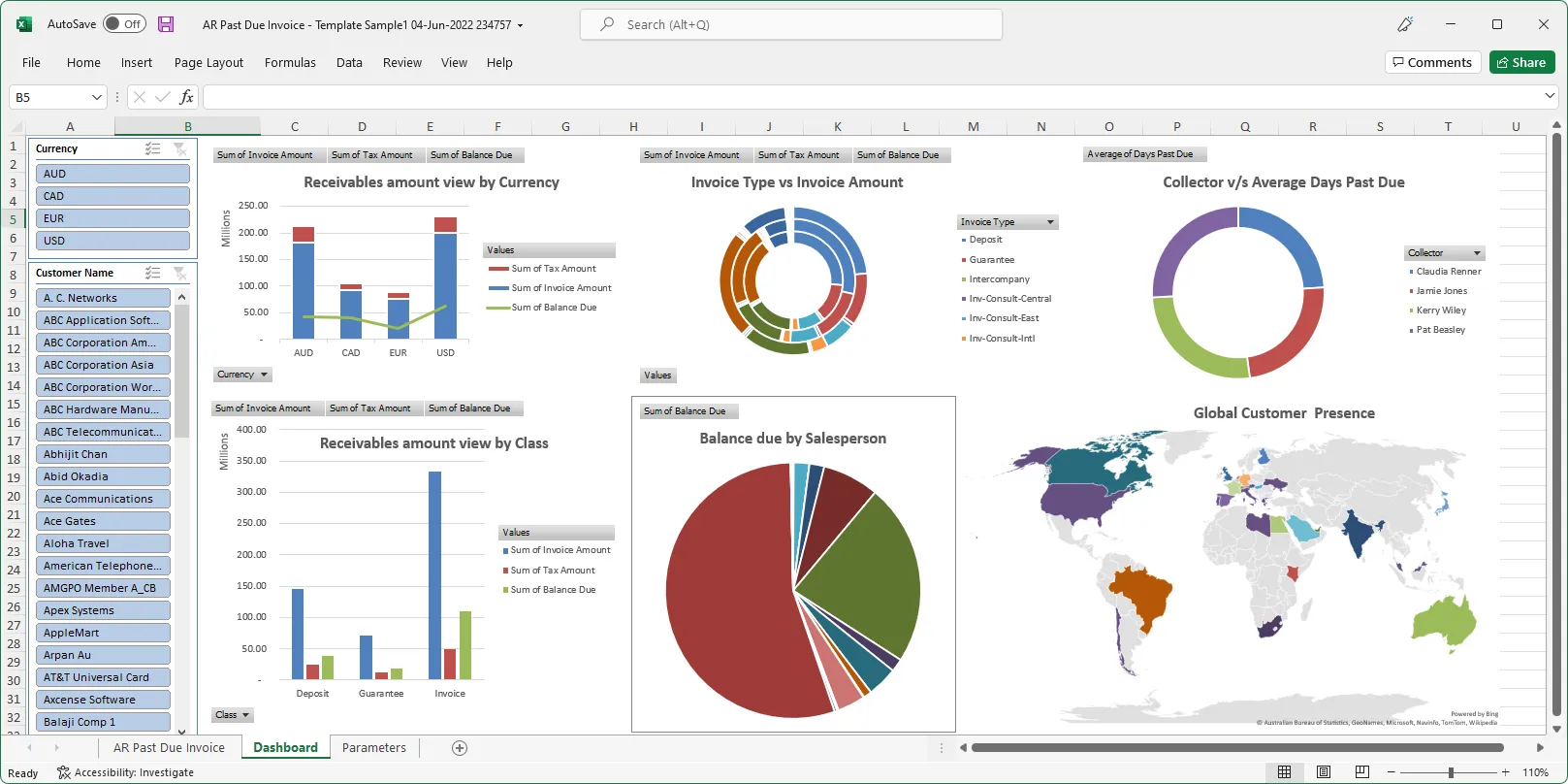
The Excel template upload functionality in Blitz Report allows users to create their own layouts by uploading an Excel template with additional sheets and charts, automatically refreshed when the report runs again. This allows to create custom dashboards and more advanced visualizations of report data.
You can download and use Blitz Report free of charge for your first 30 reports.
The installation and implementation process usually takes less than 1 hour; you can refer to our installation and user guides for specific details.
If you would like to optimize your Oracle EBS implementation and or operational reporting you can visit www.enginatics.com to review great ideas and example usage in blog. Or why not try for yourself in our demo environment.
Useful Links
Blitz Report™ – World’s fastest data upload and reporting for Oracle EBS
Oracle Discoverer replacement – importing worksheets into Blitz Report™
Blitz Report™ Questions & Answers
Supply Chain Hub by Blitz Report™
© 2025 Enginatics