XDO Publisher Data Definitions
Description:
XML Publisher data definitions or sources, associated concurrent programs, executables and templates. To include complete template information, enter a template name or wildcard % in the template name parameter field.
This report also includes the source data SQL statement extracted from the publisher data template XML file which is quite useful to quickly access and review the SQL from Oracle standard XML reports and use them as templates for new blitz report creations.
Parameter ‘Data Definition Search Text’ performs a full text search through the data template file so that you could for example enter a particular table name to list all XML publisher reports and their SQLs selecting from that table.
Parameters
Datasource Name, Datasource Code, Exclude Datasource Codes like, Concurrent Program Name, Creation Date From, Creation Date To, Show Templates, Template Name, Data Definition Search Text, Show enabled concurrents only, Show Active only, Show Datasource SQLs
Used tables
xdo_lobs, fnd_request_group_units, xdo_ds_definitions_vl, fnd_application_vl, fnd_concurrent_programs_vl, fnd_executables_vl, xdo_templates_vl, xmltable
Categories
Related reports
PO Document Types, WIP Required Components
Dependencies
If you would like to try one of these Oracle EBS SQLs without having Blitz Report installed, note that some of the reports require functions from utility package xxen_util.
Example Report
XDO Publisher Data Definitions 29-Apr-2020 114115.xlsx
Report SQL
www.enginatics.com/reports/xdo-publisher-data-definitions/
Blitz Report™ import options
XDO_Publisher_Data_Definitions.xml
Case Study & Technical Analysis: XDO Publisher Data Definitions Report
Executive Summary
The XDO Publisher Data Definitions report is a crucial development and audit tool for Oracle XML Publisher (now Oracle BI Publisher). It provides a comprehensive listing of all data definitions (data sources) used by XML Publisher, detailing their associated concurrent programs, executables, and templates. Crucially, this report offers the unique ability to extract and display the underlying SQL statement embedded within the data template XML file. This report is indispensable for developers, functional analysts, and support teams to understand the data extraction logic of standard and custom XML Publisher reports, audit their configurations, troubleshoot data issues, and facilitate the creation of new reports, especially when migrating to or developing with Blitz Report.
Business Challenge
Oracle XML Publisher is widely used for generating various business documents and reports. However, understanding and managing its data definitions can be complex and time-consuming:
- Opaque Data Extraction Logic: The underlying SQL queries that extract data for XML Publisher reports are embedded within XML data template files (CLOBs), making it difficult to quickly view and understand the exact data being retrieved without specialized tools or manual extraction.
- Troubleshooting Data Discrepancies: When an XML Publisher report produces incorrect data, diagnosing the issue requires examining the source SQL. Accessing this SQL in a production environment, especially for standard Oracle reports, is often challenging.
- Configuration Auditing: Auditing data definitions, their associated concurrent programs, and templates to ensure they are correctly linked and active is a critical but often manual and fragmented process.
- Report Migration and Development: When creating new reports or migrating from XML Publisher to other reporting tools (like Blitz Report), having direct access to the source SQL of existing reports is invaluable for understanding data models and replicating logic.
- Identifying Table Usage: Determining which XML Publisher reports select data from a specific table (e.g., when planning a table change or investigating performance) is nearly impossible without full-text search capabilities across the SQL.
The Solution
This report offers a powerful, configurable, and transparent solution for managing and analyzing Oracle XML Publisher data definitions, transforming report development and troubleshooting.
- Extracts Source SQL: The most significant feature is its ability to extract and display the actual SQL statement embedded within the XML data template. This provides immediate, clear insight into how data is being fetched for any XML Publisher report.
- Comprehensive Data Definition Overview: It lists all data definitions, their names, codes, associated concurrent programs, executables, and linked templates, providing a holistic view of the XML Publisher reporting landscape.
- Full-Text Search in SQL: The
Data Definition Search Textparameter enables a powerful full-text search directly within the extracted SQL, allowing users to find all XML Publisher reports that query a particular table, column, or specific condition. - Streamlined Troubleshooting: By providing direct access to the source SQL, the report dramatically accelerates the diagnosis of data issues in XML Publisher reports, eliminating the need for manual file downloads and parsing.
- Facilitates Report Development: Developers can use the extracted SQL as a template or reference for building new reports (including Blitz Reports), understanding complex joins, and reusing proven data extraction logic.
Technical Architecture (High Level)
The report queries core Oracle XML Publisher (XDO) and Concurrent Program tables, with custom logic to extract embedded SQL.
- Primary Tables Involved:
xdo_ds_definitions_vl(the central view for XML Publisher data source definitions).fnd_concurrent_programs_vl(for linking to concurrent programs).fnd_executables_vl(for linking to program executables).xdo_templates_vl(for associated report templates).xdo_lobs(stores the actual XML data template file, often as a CLOB, from which SQL is extracted).xmltable(a SQL function used to parse XML content within the database, critical for extracting the embedded SQL from the XML data templates).
- Logical Relationships: The report selects data definition details from
xdo_ds_definitions_vl. It then joins tofnd_concurrent_programs_vlandfnd_executables_vlto identify the associated concurrent program. When theShow Datasource SQLsparameter is enabled, the report accesses the CLOB data inxdo_lobsfor the relevant data definition, and usesxmltableto parse the XML structure and extract theSQLtag’s content, presenting the underlying query.
Parameters & Filtering
The report offers an extensive set of parameters for precise filtering and detailed data inclusion:
- Datasource Identification:
Datasource Name,Datasource Code,Exclude Datasource Codes likeallow for targeting specific data definitions. - Concurrent Program Filters:
Concurrent Program NameandShow enabled concurrents onlylink data definitions to specific runnable programs. - Date Range:
Creation Date From/Toallows for analyzing data definitions created within specific periods. - Template Inclusion:
Show TemplatesandTemplate Name(with wildcard support) are crucial for linking data definitions to their presentation layers. - SQL Content Search:
Data Definition Search Textprovides a powerful full-text search capability within the extracted SQL statements. - Display Flags:
Show Active onlyandShow Datasource SQLsdynamically control the data presented.
Performance & Optimization
As a configuration and meta-data report, it is optimized through strong filtering and specialized XML parsing capabilities.
- Parameter-Driven Efficiency: The extensive filtering capabilities (by name, code, concurrent program, dates) are critical for performance, allowing the database to efficiently narrow down the set of data definitions to process.
- Conditional SQL Extraction: The
Show Datasource SQLsparameter is crucial. The potentially resource-intensive XML parsing usingxmltableis only performed when explicitly requested, preventing unnecessary processing for simpler metadata queries. - Full-Text Search: While
Data Definition Search Textperforms a scan of XML content, it is optimized to quickly find matching SQL patterns without needing to extract and process all SQL for every data definition initially.
FAQ
1. What is the relationship between a ‘Data Definition’ and an ‘XML Template’ in XML Publisher? A ‘Data Definition’ (or Data Source) defines what data to retrieve from Oracle EBS and how to structure it (typically as XML). An ‘XML Template’ defines how that XML data should be formatted for presentation (e.g., as a PDF, Excel, HTML). This report helps you see both sides of this equation, ensuring they are correctly linked.
2. How can I use the ‘Data Definition Search Text’ to identify reports using a specific table?
You would enter the table name (e.g., PO_HEADERS_ALL) into the Data Definition Search Text parameter. The report will then search within the embedded SQL of all data definitions and return those reports whose SQL contains a reference to that specific table. This is invaluable for impact analysis during upgrades or schema changes.
3. Why is it useful to extract the underlying SQL from standard Oracle XML Publisher reports? Oracle often uses complex SQL in its standard XML Publisher reports. Extracting this SQL provides invaluable insight into Oracle’s data models and business logic. Developers can use this as a learning tool, a starting point for custom reports, or a reference when troubleshooting standard report behavior, without needing to delve into Oracle’s underlying source code.
Oracle E-Business Suite Reporting Library
We provide an open source Oracle EBS SQLs as a part of operational and project implementation support toolkits for rapid Excel reports generation.
Blitz Report™ is based on Oracle EBS forms technology, and hence requires minimal training. There are no data or performance limitations since the output files are created directly from the database without going through intermediate file formats such as XML.
Blitz Report can be used as BI Publisher and Oracle Discoverer replacement tool. Standard Oracle BI Publisher and Discoverer reports can also be imported into Blitz Report for immediate output to Excel. Typically, reports can be created and version tracked within hours instead of days. The concurrent request output automatically opens upon completion without the need for re-formatting.
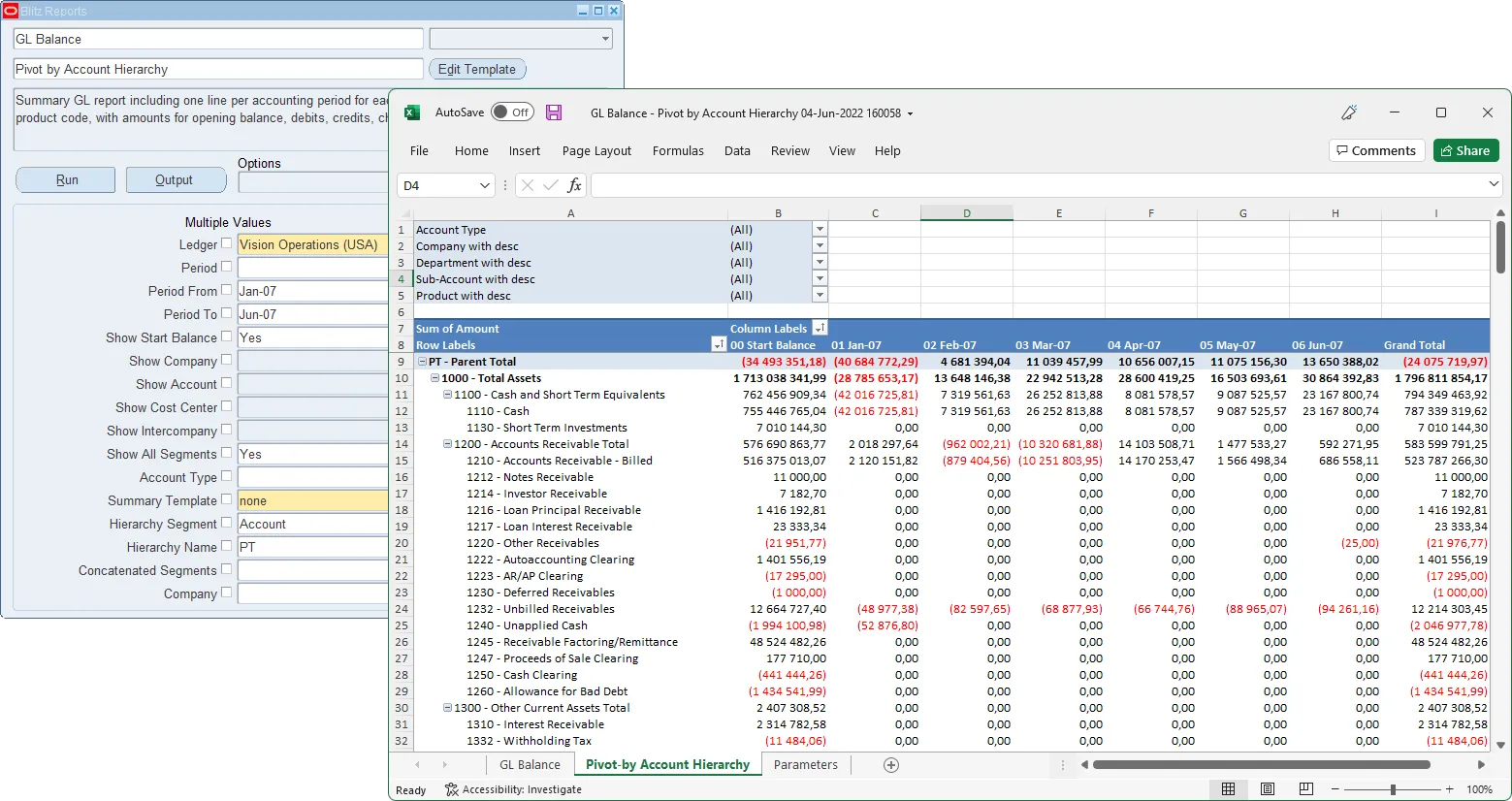
The Filters, Columns, Rows and Values fields are used to create and deliver the data in pivot table format with full drill down to details.
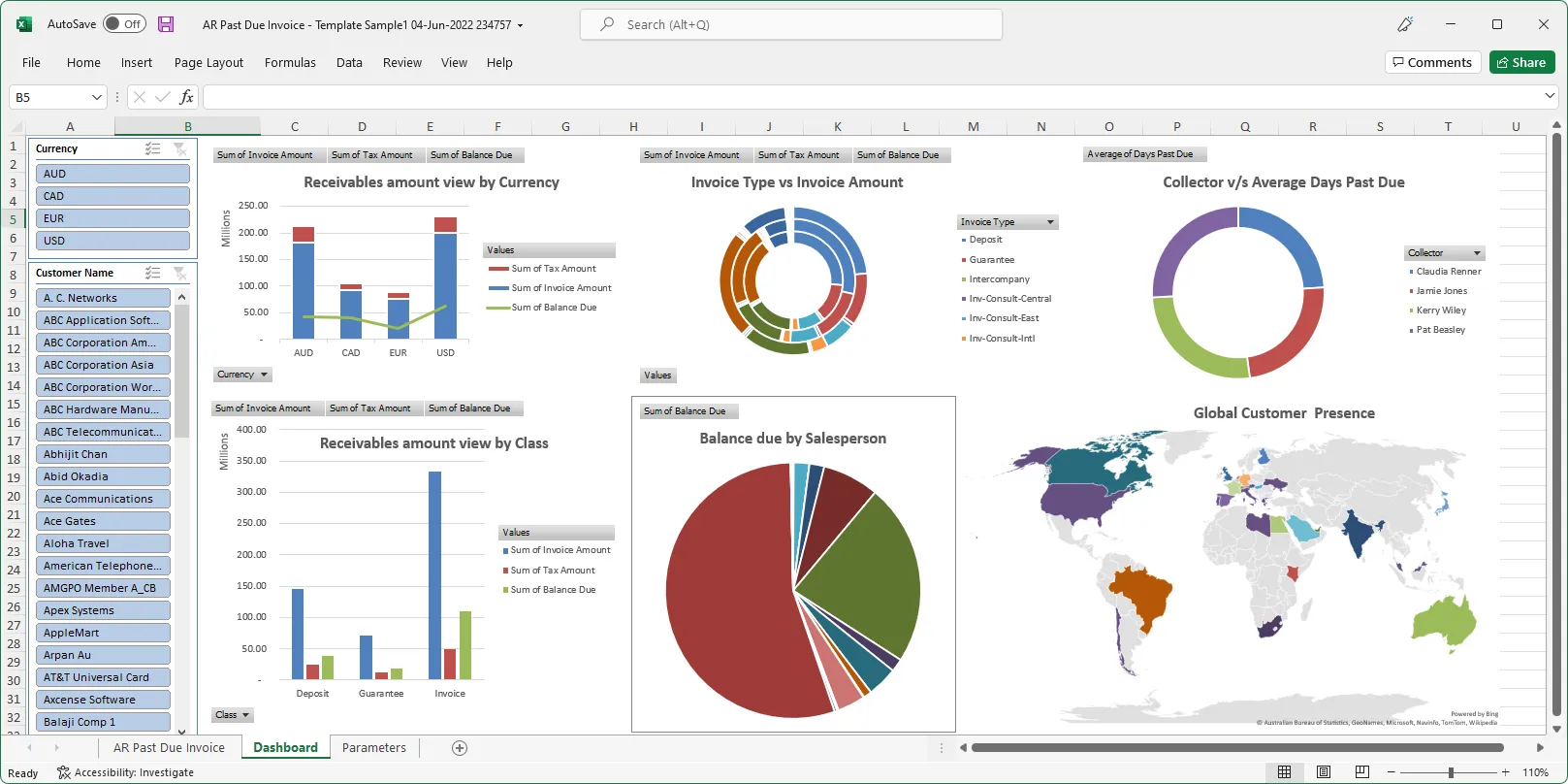
The Excel template upload functionality in Blitz Report allows users to create their own layouts by uploading an Excel template with additional sheets and charts, automatically refreshed when the report runs again. This allows to create custom dashboards and more advanced visualizations of report data.
You can download and use Blitz Report free of charge for your first 30 reports.
The installation and implementation process usually takes less than 1 hour; you can refer to our installation and user guides for specific details.
If you would like to optimize your Oracle EBS implementation and or operational reporting you can visit www.enginatics.com to review great ideas and example usage in blog. Or why not try for yourself in our demo environment.
Useful Links
Blitz Report™ – World’s fastest data upload and reporting for Oracle EBS
Oracle Discoverer replacement – importing worksheets into Blitz Report™
Blitz Report™ Questions & Answers
Supply Chain Hub by Blitz Report™
© 2025 Enginatics